
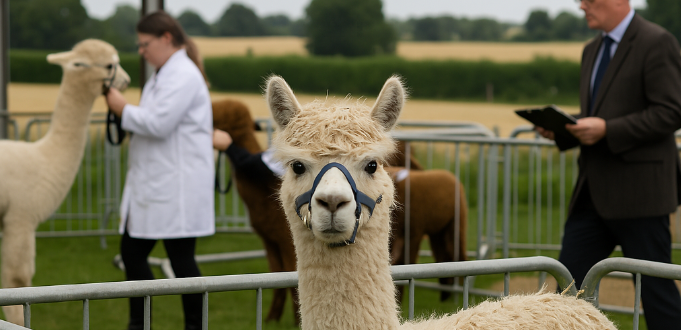
You’ve halter-trained your alpaca. You’ve brushed the hay from its fleece. You’ve driven cross-country, pitched your pen at the showground, and waited anxiously in the ring. And then, nothing. No rosette. No placing. Maybe not even a comment you could properly understand.
First of all: welcome. Every breeder, no matter how seasoned, has been there. It’s part of the learning curve. Even the best herds have animals who don’t perform in the ring, and some lessons only sink in once you’ve stood through a few of those long, cold show days.
But as frustrating as it can be, there’s almost always a reason. More importantly, there’s usually something you can do about it.
So here are ten of the most common reasons alpacas don’t place in the UK show ring, and how to turn those misses into future wins.
1) Poor Conformation
If your alpaca doesn’t walk straight, stand square, or carry its frame correctly, no amount of beautiful fleece will save it. Judges will always penalise major conformation faults. They want breeding animals that will pass on strong structure.
The issue: Crooked legs, poor topline, sway back, sickle hocks, over-angulated rear end.
Fix it: Only select animals with solid conformation for your show team. Get hands-on assessments early from an experienced breeder or judge. Breed for balance, not just fleece.
2) Lack of Uniformity in the Fleece
Uniformity is one of the most misunderstood judging criteria, especially among new breeders.
The issue: You may have fineness in the middle of the blanket, but if it changes texture at the edges or down the legs, that’s a mark against you.
Fix it: When evaluating show animals, check the consistency of micron, crimp, and handle across the entire fleece, blanket, neck, belly, legs, and rump.
“Consistency is king” is a mantra for a reason.
3) Coarse Primaries or Guard Hair
Alpacas with visible or obvious coarse fibres, especially across the midsection, will fall behind quickly. You might love your animal’s personality, but the judge has their hands in the fleece, not your heart.
The issue: Harsh primaries, medullated fibres, or guard hair appearing in the blanket zone.
Fix it: Focus your breeding programme on reducing primary fibre diameter. Evaluate progeny fleeces carefully before selecting for the show team.
4) Poor Fleece Preparation
Even a top-quality alpaca can be let down by poor presentation. Some breeders pack tiny leaf blowers to fluff out the fleece. Others just use gentle finger-combing. Find what works, just don’t ruin structure for shine.
The issue: Dirty fleece, tangled tips, obvious hay or bedding, blown-out fleece from brushing.
Fix it: Skip brushing before the ring, it ruins the crimp. Instead, use gentle picking to remove debris. Keep your bedding clean at home and use coat covers before travel. Arrive early and give the fleece time to settle.
5) Poor Handling in the Ring
You may not realise how much your handling affects the judge’s impression. An alpaca that stands confidently and walks calmly shows off its conformation and presence. Fidgety ones often don’t get looked at properly.
The issue: The alpaca is nervous, won’t stand still, constantly moves or fights the halter.
Fix it: Begin halter training early, ideally at 5–6 months. Practice standing in position for extended periods and walking confidently in busy environments. Do ring drills with friends or in local groups.
6) The Wrong Age or Maturity
Some alpacas just aren’t “show animals”, yet. Peak halter show age is usually the second spring after birth. A May-born cria shines best the following April, not six months after weaning.
The issue: Too young, gangly, underdeveloped fleece. Or, too old and past peak.
Fix it: Plan matings so your cria hit their prime showing age, between 9 and 24 months—during spring show season. Judges compare within age brackets, but younger cria will almost always lose to well-developed peers.
7) A Competitive Class
Sometimes, your alpaca is genuinely good, but the competition is simply better. Every champion once stood at the back of a class. Learn, refine, return stronger.
The issue: Entered in a strong class with elite animals from top breeders.
Fix it: Don’t despair. Ask the judge or ring steward for feedback after the class. Use fleece scorecards (if provided) to understand where you fell short. Watch top animals in your colour class and compare structure, uniformity, and fleece traits.
8) Entering the Wrong Colour Class
UK colour classification is more precise than many breeders realise. Grey alpacas are particularly tricky, especially those with uncertain patterning. Avoid entering “Grey” unless it’s a true uniform grey with no spotting.
The issue: Your alpaca was entered as “Light Fawn” but was actually Beige, or even White. You’re competing against the wrong animals.
Fix it: Get a second opinion before entering, especially with colours like rose grey, fawn, and light brown. Judges will often reclassify on the day if a colour looks clearly wrong.
9) You’re New (and Still Learning)
This is a tough one, but true. Most new breeders haven’t yet built the depth of genetics or experience to win consistently. Showing isn’t just about trophies. It’s your most valuable feedback loop.
The issue: You’re showing animals from young females or early breeding decisions that don’t yet reflect your programme’s goals.
Fix it: Keep going. Every show is a learning opportunity. Watch, listen, take notes. Buy top-up genetics through stud services or female purchases. Invest in fleece testing. Don’t rely on guesswork, use data.
10) It Wasn’t Your Day
And finally, sometimes… it just doesn’t go your way. Use it as fuel, not failure. Take what you’ve learned and apply it to your next cria, your next selection, your next entry.
The issue: A judge’s subjective preference, a fleece that didn’t settle, a slightly off day.
Fix it: Keep perspective. Showing is competitive, yes, but it’s also seasonal, situational, and sometimes unpredictable.
How to Bounce Back Stronger
Winning in the show ring is rarely about luck, it’s about layers of decision-making over years.
Breed with intent. Raise with care. Train with patience. Present with pride.
“You don’t need to win every show,” one judge told me after a long season. “You just need to show up, keep improving, and earn the wins that matter.”
So the next time you leave a show without a ribbon, remember: it’s not failure. It’s feedback. Use it well, and one day, someone else will be wondering how you keep winning.
Message from the South East Alpaca Group committee. We know that no two herds, or herd owners, are the same. We hope you found this article useful and if you’ve got ideas, suggestions, corrections, or just a different way of doing things, we’d love to hear from you. Our goal is to offer the most accurate, practical, and useful advice possible, and that works best when we all pitch in. Drop us a line at committee@southeastalpacagroup.org.uk and help us make our articles better.