
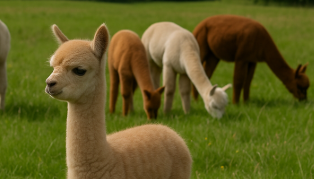

In the quiet fields of the British countryside, the birth of a cria is usually a cause for celebration. Among alpaca breeders and keepers, there’s little more rewarding than watching a healthy newborn rise on wobbly legs and begin its journey into herd life. However, particularly with small herds or in breeding programmes with variable success, a cria may find itself without peers.
This article explores the often-overlooked behavioural and developmental hurdles faced by singleton alpacas, with a particular focus on how social learning deficits can manifest, impact health, and what strategies we, as veterinary professionals and keepers, can adopt to support these vulnerable youngsters.
Alpacas are deeply social animals, descended from herd-centric camelids in the high Andes. In their natural setting, young alpacas learn critical behaviours not just from their mothers, but from observing and imitating their peers. This learning process, known as social learning, is fundamental to their development. It governs how they approach feeding, how they interact with conspecifics, and how they understand their environment.
In multi-cria herds, this learning happens almost effortlessly. One cria figures out how to use a pellet bowl, and the rest follow suit. Another starts play-fighting or exploring and soon there’s a flurry of energetic mimicry. But what happens when there’s no one to mimic?
A singleton cria, raised without same-age peers, misses out on key opportunities for early learning. This isn’t merely about entertainment or enrichment, it can have measurable developmental consequences. In practice, singleton crias can struggle with:
- Eating from bowls or engaging with feed pellets
- Interpreting social cues from older alpacas
- Establishing appropriate boundaries with herd members
- Developing confident, exploratory behaviour
These issues often lead to owners reporting what they perceive as “fussy eating,” “shyness,” or “clinginess to mum.” While some may attribute it to personality, more often it is a symptom of an under-socialised young alpaca that lacks the peer-group scaffolding most crias rely on.
Let’s consider the case of Dianna, a young female alpaca born in mid-July in the South East of England. She was the only surviving cria born that season on her holding. Raised among eight adult females, including her dam, Dianna was well-nourished on milk and engaged socially with the adults. However, by the time she was weaned, it became apparent that she had not adopted typical eating behaviours.
Despite access to high-quality grass, hay, and specially formulated pellets, Dianna refused to eat from a bowl, showed no interest in pellets, and had begun to lose condition. Hand-feeding attempts were sporadically successful, but did not establish regular intake. Her behaviour was tentative, cautious around feeders, hesitant in movement, and largely silent.
Physically, there was the possibility of a slight jaw abnormality. The most likely cause of her difficulties was behavioural: she had simply never learned to eat pellets in the absence of observing other young alpacas doing so.
It’s a natural assumption that a cria can learn all it needs from its mother. Indeed, maternal modelling is essential for survival in the early days, particularly when it comes to nursing and initial safety cues. However, adult alpacas do not typically model feeding behaviours in a way that is easily interpretable to young crias. They may not show interest in feed bowls when a cria is watching, and even when they do, the mechanics of how to engage with solid feed, how to compete at the feeder, or how to prioritise food sources are not easily gleaned from one individual, particularly across a generational divide.
Moreover, adult females may discourage young crias from crowding them at food stations, further limiting their opportunity to experiment and explore. Without peer support, this learning gap can persist well into adolescence, with tangible effects on health and confidence.
Beyond feeding, singleton crias may also experience deficits in other social domains:
- Delayed weaning independence
- Reduced play behaviour, which is important for musculoskeletal development
- Difficulty integrating into larger mixed-age herds later in life
- Submissive or overly dominant behaviours due to poor social referencing
In extreme cases, these crias may become maladapted adults, prone to aggression, anxiety, or chronic underweight status. And while many do eventually catch up, it often takes significant human intervention and careful management.
Owners are advised to contact their vet, whose role goes beyond treating illness and often advise on behavioural and husbandry strategies that prevent issues from escalating. For singleton crias, vets often recommend the following:
- Simulate Peer Learning
Introduce the cria to a slightly older weanling or juvenile alpaca if available, even from a nearby herd. Temporarily co-housing them can help stimulate observational learning, particularly around feeding. - Structured Hand Feeding
Rather than offering food ad hoc, implement consistent hand feeding sessions with positive reinforcement. Use a textured feed pan that makes noise when food is poured to associate sound with feeding time. - Modify Group Dynamics at Feeding Time
Create separate feeding spaces or offer individual bowls to reduce pressure from dominant adults. Placing a bowl in a quieter corner where the cria can explore without being pushed out is often helpful. - Monitor and Score Regularly
Weekly body condition scoring and weight monitoring is essential. As this is often the first objective sign of progress or concern, particularly when behavioural observation is ambiguous. - Encourage Environmental Exploration
Introduce toys, scent trails, or changes in terrain to stimulate curiosity. Confidence in exploration often translates to confidence in food experimentation.
While we can support singleton crias post-birth, prevention is preferable. Breeders might consider the following steps:
- Synchronised mating schedules to increase the chance of multiple crias being born within the same window.
- Partnering with nearby farms to temporarily co-house crias of a similar age during the day.
- Use of companion species, such as goats or sheep, with caution—while not substitutes for alpacas, they can offer some social enrichment if alpacas are entirely absent.
The good news is that most singleton crias, with consistent handling and careful management, do catch up. By the time they reach maturity, many are indistinguishable from their peer-raised counterparts. But the process can be slow, and the frustration, especially when feeding doesn’t seem to improve, can be demoralising.
Every positive association a cria makes with food, every gram gained, and every step toward independence is a step forward. The “lonely cria” is not broken, just delayed.
Singleton crias are a natural outcome of small herds and varying reproductive success, particularly here in the UK where many holdings are hobby or small-scale operations. While their challenges are real, they are not insurmountable.
By recognising the unique behavioural deficits that arise from a lack of social learning, and by responding with thoughtful, compassionate intervention, we can ensure these animals grow into robust, confident members of the herd.
And in doing so, we not only improve individual welfare but strengthen the future of alpaca keeping in the UK.
