
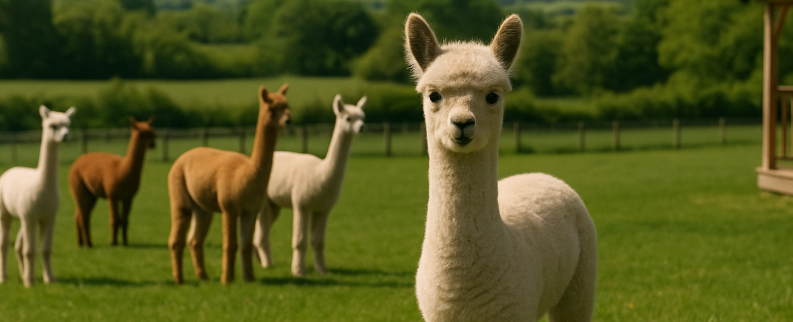
There’s a moment in every alpaca owner’s journey when you look out at your herd, perhaps lying in the spring sunshine or humming quietly while they chew, and think: Could we… breed? Maybe your girls are growing up. Maybe you’ve fallen completely in love with the idea of raising cria on your land. Maybe you’re looking to establish a small breeding business. Whatever’s planted the seed, welcome. This is where the adventure really begins.
Breeding alpacas isn’t something to dive into without thought, but nor is it something to be afraid of. It’s an immensely rewarding experience, filled with nervous excitement, sweet triumphs, and sometimes a bit of heartache. I’ve been breeding alpacas here in the UK for over a decade, and if I could go back and give myself a single piece of advice, it would be: take your time, do your homework, and build the right team around you.
Let’s talk about how to get started, what you’ll need, what to expect, and how to prepare for that magical day when you welcome your very first cria to the field.
You’ve probably got a starter herd, three to five females is typical, and you’re wondering which ones are suitable for breeding. The first question isn’t can you breed them, but should you?
A healthy breeding female should be:
- At least 14 to 18 months old
- Over 60kg in weight (ideally closer to 65kg)
- In good condition with no history of jaw misalignment, uterine infections, or other health concerns
If in doubt, a reproductive assessment by a vet experienced with camelids is worth every penny. Some breeders like to get a baseline ultrasound to check uterine tone and health before their first mating.
“Your first breeding season should be about quality” a mentor once told me. “Pick your best females and do it properly. Don’t scattergun.” Wise words.
Here in the UK, most small breeders don’t own their own stud males. It’s more common (and sensible) to use outside stud services.
There are two options:
- Mobile Mating Services – a stud owner brings the male to your farm. This is ideal for small breeders, especially if you don’t want the hassle of transport or quarantine.
Expect that the stud will only stay for a short time, sometimes only an hour or two.
- He will cover your females one by one (generally with a break in between if multiple matings are planned).
- The handler manages the male, while you provide a secure, enclosed area (ideally on grass) for the introductions.
- Have a gate or barrier in place in case you need to separate them quickly. It doesn’t happen often, but some girls really aren’t ready, and things can get shouty.
- Drive-By Mating – you transport your female(s) to the stud farm. This often includes overnight boarding or short-term stays, especially useful if you’re working with a high-profile stud. You’ll usually:
- Drop your female alpaca off in the morning
- She’ll be mated under the supervision of the stud handler
- You may collect her the same day, or she might stay 24–72 hours
- In both cases, it’s crucial to ask the stud owner for:
- A copy of the male’s BAS (British Alpaca Society) registration
- Breeding history and progeny records
- Any guarantees or re-mating terms (often they’ll offer a free return mating if she doesn’t take the first time)
For matings, you don’t need a state-of-the-art birthing barn, but a few key things make life easier:
- A Safe, Enclosed Area for Mating
Grass is ideal, less slippery and more familiar for the animals. A small paddock or fenced-off area will do. Make sure it’s visible to you but not too distracting for the animals. - A Handling Pen or Catching System
You’ll need to safely restrain your female for inspections, mating, and spit-offs (more on that later). Alpacas don’t like to be caught in open spaces, use gates and pens to make the process smoother for all involved. - Isolation Space
Newly arrived stud males should be kept apart from your herd for biosecurity reasons. Even if they’re only staying for an hour, it’s good practice to avoid direct nose-to-nose contact with the rest of the herd.
The Mating Process
Alpacas are induced ovulators, meaning they don’t have a natural cycle like sheep or horses. Ovulation occurs in response to mating. This is why timing and behaviour-based assessments are so important.
The actual mating involves the male “orgling” (a sound you’ll never forget) while the female lies in a submissive position, called a “cush.” It can take anywhere from 10 to 30 minutes.
“It’s not romantic,” as one old-timer once put it. “It’s a bit more like bagpipes and wrestling.” He wasn’t wrong.
After mating, most breeders wait about 7 days and then perform a spit-off.
The Spit-Off: A Surprisingly Effective Test
Around 7–8 days after mating, introduce the stud male again. A pregnant female will usually reject him, ears back, head up, and yes, spitting at his attempts to mount.
This is a behavioural pregnancy check and surprisingly reliable in the early weeks. A female who’s ovulated and conceived won’t want anything more to do with him.
Repeat the spit-off at:
- Day 7
- Day 14
- Day 21
Three positive spit-offs are a very good sign. If she cushed again, she likely didn’t take, and you may want to re-mate.
Confirming Pregnancy – behavioural signs are good, but we want certainty.
You have two main options:
- Ultrasound Scanning
A vet or experienced scanner can check for a fetus from about 25–30 days. Transabdominal scans are most common in the UK and usually done standing. - Blood Testing
Some labs offer progesterone testing around day 14–21. It’s less common in the UK than in the US but gaining ground.
“Don’t just rely on the spit-off,” says Lorna Hughes “It’s a great tool, but nothing beats an ultrasound for peace of mind.”
How Much Does Stud Service Cost?
Typical stud fees range from:
- £250–£500 for a solid, proven working male
- £600–£1,200+ for championship-winning bloodlines or rare genetics
Most stud owners offer:
- A live birth guarantee (or free return mating next season)
- Up to 3 spit-offs included
- Boarding for visiting females
- Some also include:
- BAS registration of cria
- Advice on genetic pairings
Good breeders will want to know about your female too, her fleece type, conformation, temperament, and history. They’re invested in producing healthy, high-quality cria, not just selling services.
What to Expect After Conception
Gestation in alpacas is typically around 11.5 months, though anything between 320 and 370 days is normal. Yes, that’s a long wait!
During pregnancy:
- Keep the female at a healthy weight
- Avoid stressful handling
- Monitor her condition monthly
- Watch out for signs of premature labour (especially in heatwaves)
- You don’t need to separate her, but closer to term, having her in a paddock near the house is helpful so you can check her easily.
Welcoming Your First Cria
This is a whole topic in itself, but a few quick tips:
- Most births occur between 9am–1pm
- Let nature take its course, intervention is rarely needed
- Have towels, iodine, and a cria coat on standby
- Make sure the baby is up, dry, and feeding within 2 hours
- Your vet should check mum and baby within 24 hours, especially for first-time dams.
And yes, you’ll cry the first time you see that wobbly little thing standing under its mum. We all do.
Breeding isn’t all spreadsheets and scanning. It’s watching a first-time mum nuzzle her cria for the first time. It’s standing in a field at dawn with a torch and a flask, waiting for hooves to appear. It’s heartbreak when things go wrong, and they sometimes do.
But when it works, it’s magic.
“It’s like the land is giving you something back,” a friend of mine said, cradling a damp, trembling cria in a towel one May morning. “You care for them, and they give you this.”
Starting your alpaca breeding journey is a big step, but if you’ve built a bond with your herd, learned their rhythms, and taken the time to prepare, it can be one of the most rewarding parts of owning these beautiful animals.
Take it slow. Ask questions. Visit other farms. Find mentors who aren’t afraid to talk about the messy bits as well as the joys. Build relationships with stud owners and your vet. And above all, listen to your girls. They’ll teach you more than any book or article ever could.
Good luck. And welcome to the breeding side of the fence.
Message from the South East Alpaca Group committee. We know that no two herds, or herd owners, are the same. We hope you found this article useful and if you’ve got ideas, suggestions, corrections, or just a different way of doing things, we’d love to hear from you. Our goal is to offer the most accurate, practical, and useful advice possible, and that works best when we all pitch in. Drop us a line at committee@southeastalpacagroup.org.uk and help us make our articles better.