
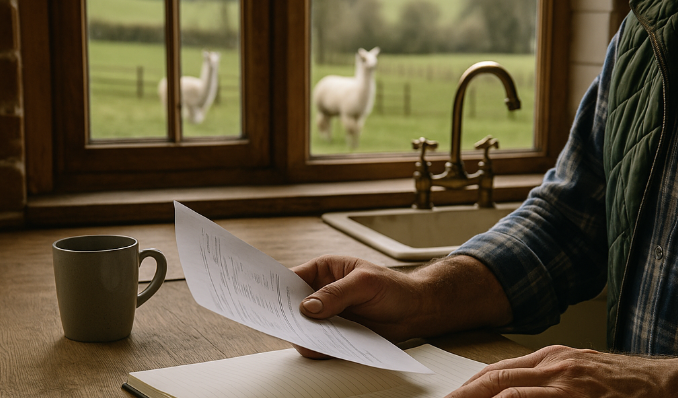
There’s a quiet storm building over the countryside, and for alpaca farmers, it could hit harder than most. For decades, farmers have relied on something called Agricultural Property Relief (APR) to protect their farms from inheritance tax (IHT). It’s meant that land, farmhouses, and the business could pass on, without the family being forced to sell up just to pay the tax bill.
But the world has changed, and fast. The new Labour government has set its sights firmly on farmers, cutting subsidies and environmental support schemes, and now one of the biggest targets in their crosshairs is Agricultural Property Relief. The idea is simple: they want to restrict it, and in some cases, take it away altogether.
If you’re farming alpacas, running holiday lets, offering trekking days or weddings on your land, you could soon find that the tax protections you thought you had no longer apply.
And when that day comes, the bill won’t be small. If you haven’t prepared, it could mean selling land, livestock, or even the family farmhouse itself, just to pay HMRC.
This article walks through:
- How inheritance tax rules are changing.
- Why alpaca farms are especially vulnerable.
- What steps you need to take, right now, to protect your farm.
- How to avoid common traps with diversification and farmhouses.
- What good advice looks like, and what bad advice to avoid.
This isn’t about doom-mongering. It’s about facing facts, getting organised, and making sure you’re not the farmer who says in five years’ time: “If only I’d done something sooner.”
Understanding Agricultural Property Relief (APR)
APR is a relief from inheritance tax that applies to agricultural property. If you qualify, it can reduce the taxable value of your land and buildings by up to 100%. This means that when you pass on your farm, your heirs might not have to pay any inheritance tax on the agricultural parts of your estate.
To qualify for APR, the property must be:
- Agricultural land or pasture used to grow crops or rear animals intensively.
- Farm buildings and farmhouses that are of a character appropriate to the land and used for agricultural purposes.
The property must have been:
- Owned and occupied for agricultural purposes for at least two years before death, or
- Owned and let for agricultural purposes for at least seven years before death.
Why Alpaca Farmers Are Potentially at Risk
Alpacas are not traditional livestock in the UK. Depending on the mood of the Government, HMRC may not automatically consider alpaca farming as qualifying for APR. The key issues are:
- Nature of the business: Is it genuinely agricultural, or more of a leisure or luxury enterprise?
- Use of the land: Is the land primarily used for grazing alpacas, or is it diversified into non-agricultural activities like holiday lets?
Upcoming Changes
From 6 April 2026, the government plans to:
- Limit the 100% relief to the first £1 million of combined agricultural and business property.
- Apply a 50% relief to amounts above £1 million.
- Allow the remaining tax to be paid over 10 years interest-free.
This means that larger estates will face a higher tax burden, and the definition of qualifying agricultural activity will be more strictly enforced.
Business Property Relief (BPR): A Possible Lifeline?
BPR provides relief from inheritance tax on business assets. If you qualify, it can reduce the taxable value of your business assets by up to 100%.
To qualify for BPR, the business must be:
- A trading business, not an investment business.
- Owned for at least two years before death.
- Assets that can qualify include:
- Land and buildings used in the business.
- Machinery and unlisted shares in the business.
Possible Risks for Alpaca Farmers
Alpaca farms that diversify into activities like holiday lets or glamping may be considered investment businesses, which do not qualify for BPR. Key considerations:
- Active involvement: Are you actively managing the business, or is it passive income?
- Nature of services: Are you providing substantial services (e.g., guided tours, educational experiences), or just renting out property?
Action Points
- Review your business activities: Ensure they are primarily trading, not investment.
- Document your involvement: Keep records of your active participation in the business.
- Separate businesses: Consider separating trading and investment activities into different entities.
The Farmhouse Trap: How to Save the 50% Relief
Farmhouses can qualify for APR, but only if they are:
- Of a character appropriate to the agricultural land.
- Occupied by someone engaged in agriculture.
If the farmhouse is too large relative to the land, or if it’s not occupied by someone actively farming, it may not qualify.
Common Pitfalls
Retired farmers: If you’ve retired and are no longer actively farming, the farmhouse may lose its qualifying status.
Diversification: Using the farmhouse for non-agricultural purposes (e.g., B&B, holiday let) can disqualify it.
Action Points
- Maintain active farming: Ensure that someone actively engaged in agriculture occupies the farmhouse.
- Keep records: Document the agricultural activities conducted from the farmhouse.
- Seek professional advice: Consult with a tax advisor to assess your specific situation.
Holiday Lets, Diversification, and Danger Zones
Diversifying into holiday lets, glamping, or other non-agricultural activities can jeopardise both APR and BPR. HMRC may view these as investment activities, which do not qualify for relief.
What Activities Are Potentially Risky?
- Passive holiday lets: Renting out properties without providing substantial services.
- Glamping: If it’s primarily an accommodation business without active involvement.
- Weddings and events: Hosting events may be considered non-agricultural.
What Activities Might Qualify?
- Educational experiences: Offering alpaca trekking or farm tours with active participation.
- Farm shops: Selling products directly from the farm.
- B&Bs with services: Providing meals and daily housekeeping.
Action Points
- Assess your activities: Determine whether they are trading or investment in nature.
- Provide substantial services: Enhance your offerings to include active services.
- Document everything: Keep detailed records of your involvement and services provided.
Tenancies and Farm Structures: Get It Right or Risk Losing More Than You’d Like
Having the correct legal and business structures is crucial to qualify for APR and BPR.
Common Issues include:
- Informal arrangements: Operating without formal agreements can lead to disqualification.
- Hobby farming: If the farm is not run as a genuine business, relief may not apply.
Action Points
- Establish formal tenancies: Use Agricultural Holdings Act (AHA) or Farm Business Tenancy (FBT) agreements.
- Set up proper business entities: Consider forming partnerships or limited companies.
- Maintain financial records: Keep detailed accounts demonstrating active trading.
What Alpaca Farmers Should Consider Doing
- Conduct a full audit: Review your business activities, structures, and property uses.
- Consult professionals: Engage with tax advisors and solicitors specialising in agricultural taxation.
- Separate activities: Distinguish between trading and investment activities legally and financially.
- Update documentation: Ensure all agreements, records, and accounts are current and accurate.
- Plan for the future: Consider succession planning and potential tax liabilities.
The Time for Action Is Now
The upcoming changes to inheritance tax reliefs pose significant risks to alpaca farmers, especially those involved in diversified activities. By understanding the rules, assessing your current situation, and taking proactive steps, you can protect your farm and ensure its continuity for future generations.
Don’t wait until it’s too late. Act now to safeguard your legacy.
Disclaimer: This article is provided for general informational purposes only and does not constitute legal, tax, or financial advice. SEAG is not authorised or regulated by any professional body, including the Chartered Institute of Taxation (CIOT), the Association of Taxation Technicians (ATT), or the Institute of Chartered Accountants in England and Wales (ICAEW), and is not registered with HMRC as a tax adviser. Always consult with a suitably qualified and regulated professional to obtain advice tailored to your individual circumstances.