
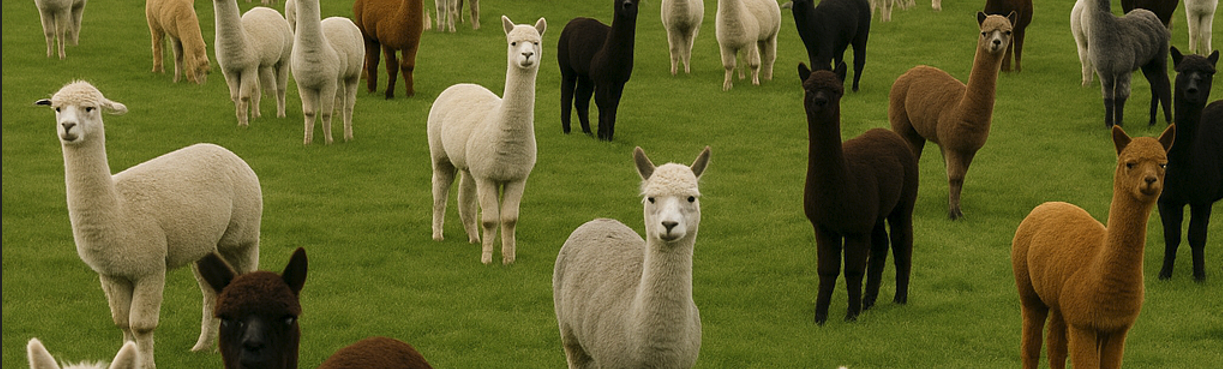

An editorial exploration into a future where alpaca fibre is as beloved, and as ubiquitous, as sheep’s wool…
It’s the spring of 2038, a woman steps out of her cottage in Kent, her coat is soft, supple, naturally water-resistant, and the colour of warm oatmeal. She runs her fingers along the seam. “British alpaca,” the label reads, “spun in Sussex”
Her dog trots alongside her. His jumper is also alpaca. Ethically shorn. Locally woven. Compostable, if it ever came to that.
She smiles. Somewhere in the distance, she hears humming.
It’s hard to overstate just how under-the-radar British alpaca fleece has been. Despite its outstanding softness, warmth, and hypoallergenic properties, it’s remained a niche material, beloved by smallholders, hand-spinners, and a few high-end craft circles, but virtually unknown to the average shopper.
For decades, it has existed in the shadow of the UK sheep industry, a giant of production, tradition, and sheer woolly momentum. While sheep’s wool has benefitted from millennia of breeding, marketing, and infrastructure, alpaca fleece has quietly accumulated in barns, repurposed as nest-liner, mulch, or wishful dreams of one day “doing something with it.”
But then came the change. A shift in values, in consumer habits, in climate, in rural economies, and the alpaca finally stepped forward.
Let’s time-travel back from our Kent cottage to the messy middle. Because revolutions, even fleece-based ones, never happen overnight.
The Sustainability Surge
By the late-2020s, the fashion industry was at war with itself. Consumers, weary of synthetic fabrics, fast fashion, and microplastics, began demanding transparency. The carbon footprint of cotton was exposed. The horror of polyester revealed. Natural fibres surged in popularity.
But not just any natural fibre. People wanted luxury. They wanted softness, durability, provenance. They wanted what alpaca offered.
And suddenly, those gentle grazing creatures weren’t just field ornaments. They were climate heroes with fleece like clouds.
Farming Diversification and Rural Revival
Across the UK, small farms, especially in marginal areas where sheep were less profitable, began turning to alpacas not just for companionship or tourism, but as a serious fibre proposition.
Government incentives helped, nudged along by sustainability goals and post-Brexit land-use reform. The rural economy, desperate for reinvention, leaned in. Local councils got excited. Fibre mills sprang up in the Midlands. Courses ran at agricultural colleges.
By 2030, alpaca fleece wasn’t a joke at a country fair. It was an asset class.
Fashion Fell for the Fleece
It started with the indie designers. A Bristol knitwear label launched a line of un-dyed British alpaca jumpers. A Devon-based artisan dyed fleece using hedgerow plants. A Scottish mill, historically devoted to sheep’s wool, trialled an alpaca blend and couldn’t believe the softness.
Then the majors caught on. British heritage brands rebranded their rural lines. Mulberry added alpaca shawls. Liberty stocked local weavers. John Lewis ran a Christmas line of socks “as soft as snow, as British as tea.”
Once Vogue ran a cover story on “The Return of the Real Wool,” there was no going back.
Building the Backbone
But fleece fame comes with challenges. The alpaca industry had to grow up—fast.
Previously, most alpaca fleece in the UK was shorn into individual feed bags and hoarded like some ancient tax payment. It was too little, too diverse, and too poorly sorted to be of use to commercial buyers.
The shift came when regional co-ops began forming. Inspired by the NZ model, British alpaca breeders pooled fleece, sorted by grade and colour, and sent it to professional sorters and fibre brokers.
“British Alpaca North” handled fleece from Cumbria to Northumberland. “Heart of England Fibre Co-op” covered the Midlands. Fleeces went further, together.
Suddenly, the commercial scale was possible. Mills had a reason to invest. Brands had a supply chain. The fleece flowed.
Selective breeding turned from conformation and cuteness to fibre stats. Fleece length, micron count, uniformity, tensile strength, these became the buzzwords.
Stud males with elite fleece genetics commanded real value. Fleeces were tracked not by vague colour but by objective quality. Data mattered.
Shows introduced fibre-only categories. Farms tracked fleece metrics like they were champagne vintages. Fleece awards were no longer a pat on the back, they were part of the marketing plan.
The alpaca was no longer just a pet or niche livestock. It was a producer.
The Future Landscape
So, what does a fully-fledged British alpaca fleece industry look like in this brave new world?
Regional Mills and Micro-Processing. Every region has its hub, a fibre mill that processes local alpaca. Many are former sheep wool mills, resurrected with new machinery and new passion.
Some handle small-batch fleece for cottage industry crafters. Others deal in tons, creating semi-worsted yarns for fashion houses. Tourists can visit. School groups can watch the carding machines whirl.
You can trace your jumper from paddock to pullover, via a mill only 30 miles from the alpacas that grew it.
High Street, High End, High Ethics. Clothing labels proudly state: “100% British alpaca.” But it’s more than just a label. It means low-carbon. It means fair pay. It means animal welfare. No chemical treatments. No offshore spinning.
Alpaca appears everywhere:
- School jumpers
- Luxury suits
- Equestrian wear
- Hospital-grade hypoallergenic bedding
- Babywear (because, of course)
It’s affordable, because scale brings efficiency. It’s aspirational, because softness is eternal.
Alpaca farmers are no longer the oddballs at agricultural conferences. They sit on DEFRA panels. They host fashion interns. They sell breeding services, fleece shares, and subscription boxes.
Their income is diversified. Their marketing is slick. Their animals are still weird and wonderful, but they’re also professional contributors to the rural economy.
Some run shearing circuits. Others offer on-farm fleece processing. A few have launched full fashion labels.
The days of “it’s just a hobby” are long gone.
What It Took to Get There
This alpaca fleece renaissance wasn’t inevitable. It took years of stubborn dedication from breeders, industry leaders, and fleece evangelists.
It took:
- Training – in shearing, sorting, breeding, and processing
- Infrastructure – real investment in mills, storage, and distribution
- Education – from schoolchildren to fashion buyers to policymakers
- Marketing – so much marketing, to overcome old perceptions
- Collaboration – between farms, regions, and organisations
It also took listening, to the alpacas, to the fibre, to the consumers. British alpaca didn’t just become popular because it was better. It became popular because people saw its potential and did the hard work to make that vision real.
Looking Back from the Future
Let’s return to our woman in Kent. She walks to her local market where she sells handmade scarves, all woven from her own herd’s fleece. Her customers know her alpacas by name. The scarves sell out every month.
Later, she scrolls through Instagram. One of the top fashion influencers is wearing a British alpaca cape. “Sustainable luxury,” the caption reads. “Better than cashmere. Kinder than wool.”
She smiles. The fibre that once filled her barn with hope and hay dust now fills wardrobes, catwalks, and carbon-offset spreadsheets.
The alpaca didn’t just arrive. It triumphed.
Epilogue: What Can You Do Today?
This future isn’t guaranteed. But it’s possible. And every breeder, spinner, designer, and alpaca fan can help build it.
Start by:
- Skirting and sorting your fleece properly
- Connecting with local mills and craftspeople
- Tracking your fibre stats
- Educating customers about what makes alpaca special
- Treating fleece as a crop, not a by-product
- Collaborating with others in your region
Because somewhere out there, someone is about to buy their first alpaca jumper, and it could be made from your herd’s fleece.
The revolution is soft. The revolution is quiet. The revolution is humming in the field.