
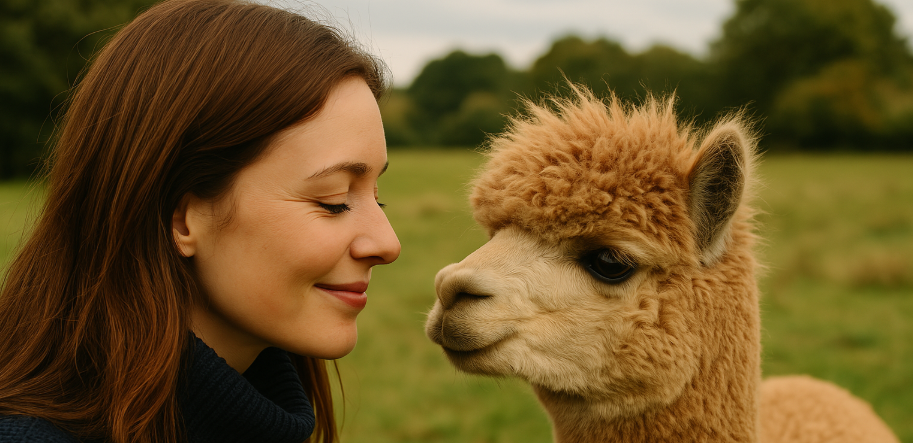

Seeing a field of Alpacas is still relatively rare, however could these gentle creatures help heal Britain? They hum. Soft, low, melodic, like a lullaby woven into the wind. I first heard the sound in East Sussex, standing beside a paddock at dusk, alpacas silhouetted against a peach-washed sky.
“That’s how they talk,” Claire Brown of Weald View Alpacas told me. “It’s a kind of contentment. Or concern. Or curiosity. Depends on the day.”
It stayed with me, that hum. Not just because of its beauty, but because it felt like a key to something we don’t quite understand yet: the deep, almost inexplicable bond humans are forming with alpacas.
We already know about their fleece. We’re learning how to breed them well. But the quiet revolution underway in some specialist schools, care homes, children’s hospitals and the odd prison isn’t about agriculture. It’s about wellbeing. It’s about therapy. And it’s changing lives in ways no one expected.
The use of animals in therapy isn’t new. Dogs, horses, even rabbits have long served as companions and healers. But alpacas bring something different: they are exotic but approachable, alert but gentle. They are calm without being sleepy, present without being pushy.
“Children just connect with them,” said Janet Morris, a former SEN teacher who now runs an alpaca therapy programme in the Cotswolds. “We had a boy with selective mutism who didn’t speak for weeks. One day, he walked into the paddock and whispered to our alpaca, Chester. It was the first word he’d said in school.”
Alpacas, she explained, respond to energy. Loud, erratic movements make them skittish. But soft, grounded energy draws them in. “So the children have to regulate to engage. It’s brilliant for those with autism or ADHD. It can help teach emotional control without anyone preaching to them.”
In Manchester, a mental health charity offers weekly alpaca walks through parkland. In Wales, a prison pilot scheme reported a drop in disciplinary incidents among inmates working with a small therapy herd. In rural Kent, a dementia care centre uses alpaca visits to stimulate memory and reduce anxiety.
Dr. Helen Carter, a clinical psychologist who studies animal-assisted therapy, said the science is catching up to the anecdote. “Alpacas aren’t domesticated in the same way dogs are. They retain a degree of wildness, and people feel that. There’s a quiet respect. It invites presence, gentleness, and empathy.”
So what makes alpacas uniquely suited to this work?
- Non-verbal communication: Alpacas read body language, not words. They model calm.
- Hypoallergenic fleece: They’re safer for environments with medical sensitivities.
- Novelty factor: Their appearance, halfway between a deer and a cloud, captures attention and softens barriers.
- Respectful boundaries: They don’t nuzzle or beg. They approach on their terms, teaching consent and awareness.
But perhaps it’s something even simpler: they make people smile. And in some settings, that’s nothing short of transformative.
I visited a farm in Surrey to see a pilot “Alpacas for Calm” session in action. A small group of teenagers were brushing fleece, laying out feed, and walking quietly around the pasture.
One girl, Lucy, had been school-refusing for months. “I didn’t want to be anywhere with people,” she told me. “But alpacas don’t expect you to talk. They’re just… there.”
Claire has trained her animals carefully, only selecting those with the right temperament. “It’s not just about putting an alpaca in a school and hoping for the best,” she said. “It’s a process. But the outcomes, well, we’ve seen kids come out of shells, carers cry with relief. It’s powerful.”
There is growing demand for formal accreditation and ethical standards in alpaca-assisted therapy. The British Alpaca Society is exploring this, and some owners are partnering with therapists to create structured programmes. But there’s a delicate balance to maintain, between commercialisation and care, between the animals’ welfare and the humans they help.
And yet, as we walk further into a century shadowed by stress, isolation, and burnout, these gentle camelids may prove to be more than companions. They might be guides — not just through muddy fields, but toward stillness, softness, and something slower.
Back at pilot session, as the teenagers laughed quietly and the alpacas grazed around them, that hum rose again, low and peaceful, drifting across the grass like a secret you didn’t know you needed to hear.
Thinking of Starting an Alpaca Therapy Programme?
- Training: Select calm, confident animals; consult with behaviour specialists.
- Insurance: Public liability and risk assessments are essential.
- Partnerships: Work with therapists or schools to design structured sessions.
- Welfare First: Limit sessions. Provide rest and retreat spaces for the animals.
- Accreditation: Consider joining or supporting bodies developing national standards.
If you’re just starting out, and thinking of getting alpacas? The British Alpaca Society offers free resources and a directory of accredited breeders. Also consider joining the South East Alpaca Group, a volunteer group affiliated with the BAS, who support alpaca and llama enthusiasts across the South East of England.