
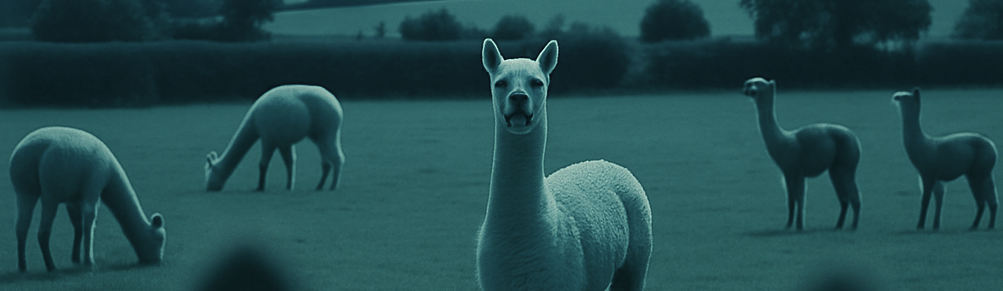

Let’s be honest, when most people look at an alpaca, they’re thinking about how soft its fleece looks, how grumpy its face is, or whether they can sneak a selfie without getting spat on. Very few pause to ask, “What’s it like to be that alpaca?”
For those of us lucky enough (or stubborn enough) to share our lives with alpacas, understanding how they sense the world is key to good welfare, better training, smarter handling, and fewer panicked stampedes when someone leaves a wheelbarrow in the wrong place.
So let’s dive in, literally nose-first, into the incredible sensory world of alpacas. We’ll break it down by their four primary senses: sight, hearing, smell, and touch. (Yes, they have taste too, but frankly, that’s a whole other story and a lot less useful unless you want to discuss how mine once refused anything that wasn’t served in the pink bowl).
Sight: Panoramic, Weirdly Cautious, and Terrible in the Dark
Alpacas have the kind of eyes that are so expressive they could star in a Victorian novel. They blink mournfully. They gaze with mild suspicion. They dart sideways with the precision of a Wimbledon ball girl. But what can they actually see?
Alpacas, like all camelids, have laterally placed eyes, meaning they sit far out on either side of the head. This gives them almost 320 degrees of panoramic vision, with a narrow blind spot directly behind their rump and a small overlap at the front that allows for limited binocular vision.
That’s great for scanning for predators, but it does have trade-offs:
- They’re not good at judging distance up close.
- They struggle to focus on small or nearby details.
- Depth perception? Questionable at best.
Add to that a relatively poor ability to see in low light, and it’s no wonder your herd starts acting spooky at dusk or refuses to go into a dark shelter.
Alpacas also seem to perceive movement better than detail. A rustling leaf might trigger a full alert, while a child crouched in the grass might go unnoticed, until they move.
Colour vision in alpacas is limited but probably exists in some form. Camelids are thought to have dichromatic vision, meaning they likely see blues and yellows, but not reds and greens. So that bright red halter you thought was fashionable? They may see it as an ominous brownish-grey.
Be aware of their blind spots. Approach from the front or side, never from directly behind unless you enjoy being kicked by an animal with zero regret.
Lighting matters. Don’t expect your alpacas to confidently walk into a dark stable. Use natural light or low-glare LEDs if you’re encouraging them indoors.
Movement is key. If you’re training them or introducing something new, let them see it move slowly first. Sudden, jerky motion? Spook city.
Feed bowls and buckets are best placed in predictable locations. Changing their position may cause hesitation, especially in anxious animals.
Bottom line? Alpacas see the world in wide, cautious glances, with a penchant for motion detection and a distrust of shadows. Be deliberate, consistent, and patient, and they’ll learn to trust what they see.
Hearing: Ears Like Satellites, Reactions Like Ninjas
If alpacas were spy equipment, their hearing would be top-tier MI5. Those twitchy banana-shaped ears aren’t just for show, they’re tuned in to every rustle, whisper, and faraway bird sneeze. I’ve seen a herd go on red alert because someone two fields away sneezed into a fleece.
Alpacas have highly mobile, independently rotating ears, each capable of pivoting toward different sounds like little radar dishes. Their hearing is sensitive across a broad frequency range, with an acute ability to detect high-frequency sounds, many of which are inaudible to us.
Some studies in camelids suggest they hear in the 16 Hz to 25,000 Hz range. That’s similar to a horse, but slightly narrower than a dog’s hearing. What this means practically is:
- They hear much higher pitches than we do.
- They’re more sensitive to sudden or sharp sounds.
- They can pinpoint the direction of sound with surprising accuracy.
Alpacas also hum. A lot. This soft, melodic hum is thought to be a form of low-level communication, a sort of “I’m here, are you there?” contact call. Stress hums, greeting hums, worried mum hums, they all exist, and alpacas can differentiate between them.
Minimise sudden noises. Loud bangs (like a dropped gate or a barking dog) can trigger a flight response. Respect their eavesdropping. They hear you walking long before you open the gate. Move confidently but calmly.
Use voice tone. While they don’t understand words, they absolutely respond to the tone. A calm, rhythmic voice helps settle nervous animals.
Avoid ultrasonic pest repellents. These devices, often used in barns or gardens, can be distressing for animals with sensitive hearing.
Pro tip: If you need to call your alpacas in and they’re trained to associate your voice or a whistle with food, don’t shout—just whistle softly or sing your usual “feed time” tune. They’re listening. Always.
Smell: Underestimated, Subtle, and Occasionally Disgusting
Alpacas have a slightly mysterious relationship with smell. They’re not scent-driven in the way dogs or pigs are, but their sense of smell is not to be underestimated. And when it comes to the social side of things, marking, mating, or sniffing that one weird thing in the paddock, it’s all about the nose.
Alpacas have a well-developed olfactory epithelium, though less extensive than true scent hounds. Their nasal cavity is sensitive enough to:
- Identify familiar individuals by scent
- Detect pheromones (especially during breeding)
- Suss out contaminated food or dodgy water
- Explore dung piles for social and territorial cues
And then there’s the flehmen response, that lovely moment when an alpaca curls its lip and inhales dramatically. This isn’t because your deodorant is offensive. It’s how they expose scents to their vomeronasal organ (VNO), a special structure in the upper palate that processes chemical signals.
They’ll do this around:
- Fresh poo
- New crias
- Breeding females
- Weird smells in buckets
So yes, they’re sniffy little detectives when they want to be.
Don’t clean everything all the time. Scent marking is a key part of how they identify shared spaces. Over-sanitising shelters or dung piles can stress them out.
Let them sniff you. If you’re new, let them explore your hands, coat, or boots. It’s how they learn who you are.
Respect the dung pile. They use it as a social noticeboard. If a newcomer avoids the communal latrine, the herd will take note.
Watch for sudden changes. If an alpaca sniffs food and walks away, investigate. They may be detecting spoilage or contamination.
In short: alpacas don’t lead with their noses, but when they sniff, they mean it. Give them time to assess and trust their olfactory instincts, they’re rarely wrong.
Touch: Subtle, Social, and Hug-Free
If you’ve ever tried to hug an alpaca and walked away covered in spit and regret, you’ve learned an important truth: alpacas have very specific opinions about touch. Namely, touch is on their terms, not yours.
But that doesn’t mean they’re not tactile. In fact, touch is a vital part of alpaca communication, especially between mothers and crias, close companions, and rivals testing boundaries.
Alpacas have sensitive skin, particularly along their flanks, belly, and legs. Their fleece acts as insulation, but also a buffer against too much direct contact. They don’t have the same tactile curiosity as goats, nor the grooming habits of horses, but they do use touch to communicate:
- Mothers nuzzle crias during bonding and nursing.
- Friends lie beside each other or graze shoulder-to-shoulder.
- Dominant animals will shoulder-bump or stand over others in challenge.
They also have sensitive feet, which is why handling their toes can be so controversial. Many alpacas object vocally and physically when their feet are lifted, especially if they haven’t been trained gently.
Avoid sudden pats. Alpacas dislike surprise contact, especially on their heads or backs. They prefer calm, predictable approaches.
Use touch positively. If they allow a scratch on the neck or chest, use that to build trust. Don’t force contact where it’s not welcomed.
Train foot handling early. Start when they’re young, use positive reinforcement, and never rush the process.
Watch their body language. An alpaca leaning away, stiffening, or twitching the skin is saying “no thanks.”
The best touch is often no touch, or rather, touch offered on the alpaca’s own schedule. And when they do lean in, even just slightly? That’s the equivalent of a full cuddle.
Bringing It All Together: Living with a Creature Who Senses Differently
Understanding alpacas’ senses isn’t just trivia, it’s a powerful tool for:
- Reducing stress during handling, shearing, or medical care
- Training with respect instead of force
- Designing better shelters, paddocks, and interactions
- Becoming a more trusted presence in their world
When we know that an alpaca:
Can’t see the halter clearly when it’s under their nose
- Can hear the bucket rattle from 200 metres away
- Is sniffing the breeze for familiar friends
- Is shuffling away because they’re not a fan of surprise belly rubs…
…we become better caregivers. And, arguably, better humans.
Final Thoughts: The Alpaca’s World is Bigger Than Ours
In the end, alpacas experience the world differently, not worse, not better, just… differently. They live by glances, hums, shifts of wind, and the distant bleat of a rival two fields over. Their sensory world is quiet, alert, detailed, and constantly changing.
As keepers, our job isn’t to impose our noisy, visual, touchy-feely selves on them. It’s to learn their language. Tune into their senses. Respect the boundaries of a creature who’s been watching condors on the Andes for millennia.
And maybe, just maybe, if we really pay attention, we’ll notice the world a bit more like they do: with open eyes, twitching ears, flared nostrils, and a deep appreciation for a sunny spot in a well-fenced field.
If you’re just starting out, and thinking of getting alpacas? The British Alpaca Society offers free resources and a directory of accredited breeders. Also consider joining the South East Alpaca Group, a volunteer group affiliated with the BAS, who support alpaca and llama enthusiasts across the South East of England.