
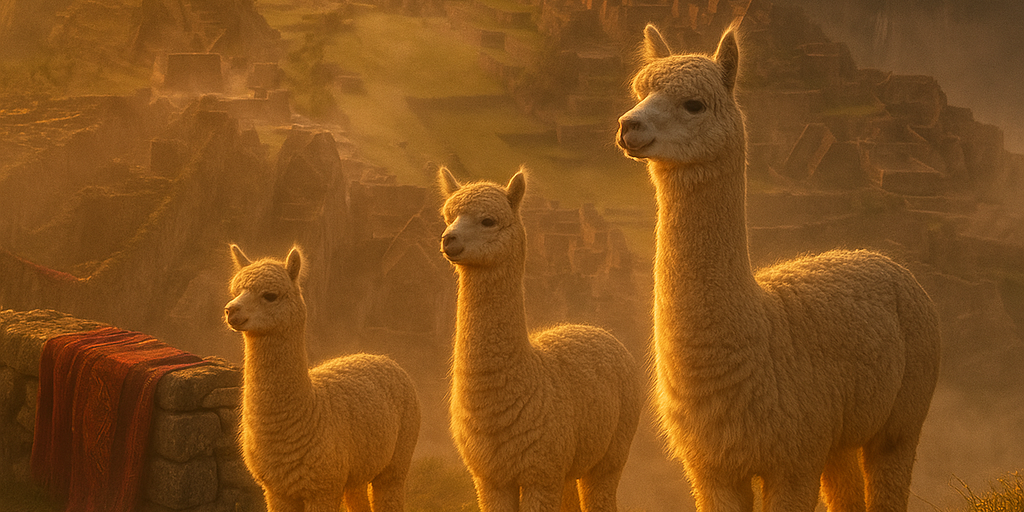

There’s something otherworldly about an alpaca. Perhaps it’s the eyelashes, long enough to make movie starlets jealous. Or the quiet, humming communication that seems more spiritual than animal. Maybe it’s the way they appear to be always watching, always listening, yet rarely in a hurry to do anything about it.
Spend enough time with them, and it’s easy to understand why alpacas have earned their place not just in paddocks across the British countryside, but in mythology, ancient, local, and modern.
So I set out to trace their stories. From the cloud-wreathed peaks of the Andes to British folklore (yes, it exists), the alpaca has long been more than just a curious creature with an excellent fleece.
We begin in Peru, the true cradle of alpaca mythology. Long before the Incas, the people of the high Andes revered the alpaca and its sturdier cousin, the llama, as sacred gifts from the mountain spirits, the Apus. These towering, sentient peaks were believed to provide water, weather, and protection. In return, the people offered coca leaves, maize, and sometimes even the blood of a prized camelid in ritual sacrifice.
In the Incan creation myths, the alpaca came from the stars, a celestial animal sent down by Pachamama, the Earth Mother, to help humanity survive. It was never meant to stay on Earth forever. And so, the legend goes, if the alpaca is mistreated or undervalued, it will return to the heavens, taking its soft fleece and sure-footed blessings with it.
The Inca elite wore garments made of alpaca fleece so fine it rivalled silk. White-fleeced animals were especially revered, thought to carry divine power. High priestesses spun it into thread for ceremonies and solstice rituals. Even today, in remote Quechua communities, alpacas feature in traditional dances and songs, symbols of fertility, prosperity, and calm.
“They’re still honoured,” said Rosa, a guide I met in the Sacred Valley. “We ask their permission before shearing. And we say thank you, even if they spit.”
And yes, even the spitting has a story. In ancient tales, alpacas were once mute. But when the gods flooded the earth, it was the alpaca who cried out, warning the people and saving lives. Its “spit” was originally a sacred mist, breath from the gods, that warned of changes in the weather.
While they may not have ancient roots in Britain, alpacas have quickly found their way into the hearts, and folklore, of modern British alpaca owners and visitors alike.
An alpaca owner in Surrey told me her herd hums loudly before storms. “Always right, too. Better than the Met Office.”
As trekking and therapy experiences grow, so do the legends. Alpacas are now seen as intuitive, calming, even psychic. Walkers report emotional breakthroughs, moments of “connection.” Therapists speak of breakthroughs with neurodivergent children or trauma patients. These soft-footed creatures, it seems, are becoming part of a new kind of British folklore, one grounded not in ancient tales, but in lived experience.
Perhaps the most charming modern myth is the idea of the Alpaca Sentinel. Many smallholders report their alpacas acting like gentle watchdogs, alert to intruders, protective of lambs or poultry, quick to spot a fox, pheasant, or cat.
“There’s something almost knightly about them,” Claire Brown of Weald View Alpacas in East Sussex tells me. “They stand firm. They hold their ground. I’ve seen them form a semi-circle around a couple of pheasants that dared to walk through their field.”
And maybe that’s what makes them legendary. They’re both soft and stoic. Kind but cautious. Like the heroes of many a myth, they possess a quiet strength that doesn’t need to shout to be felt.
In a world hungry for reconnection with nature, with slowness, with gentleness, the alpaca has come into its own. It doesn’t surprise me that these animals have birthed new stories on British soil. Stories of healing, humour, and a touch of the extraordinary.
One day, future generations might tell tales of the Great British Alpaca: who watched over the fields, hummed in harmony, and made an anxious child speak. Not as ancient gods, perhaps, but as gentle guardians of a new kind of sacred, the pastoral peace we’re all craving.
If you’re just starting out, and thinking of getting alpacas? The British Alpaca Society offers free resources and a directory of accredited breeders. Also consider joining the South East Alpaca Group, a volunteer group affiliated with the BAS, who support alpaca and llama enthusiasts across the South East of England.