
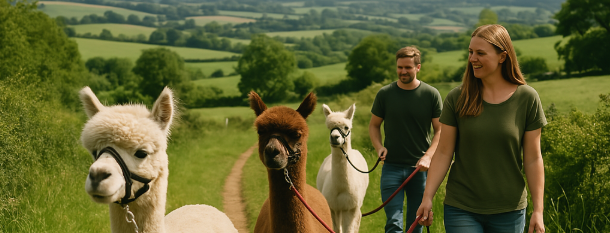

Somewhere on the edge of the South Downs, I found myself walking up a chalky trail behind an alpaca named Bertie. He had deep brown fleece, a patient gaze, and a way of flicking his ears that made it quite clear who was in charge. Behind us, six more alpacas trotted in single file, each tethered to a grinning walker with muddy boots and a camera around their neck.
“They always know the route,” our guide told me, with a half-laugh. “Sometimes I think they’re walking us.”
This, it turns out, is not an uncommon experience.
From Cumbria to Cornwall, alpaca trekking has quietly become one of rural Britain’s most charming, unexpected, and oddly lucrative pastimes. What began as an eccentric offshoot of animal husbandry is now an industry unto itself, part wellness experience, part petting zoo, part Instagram goldmine.
But it begs the question: do alpacas actually like being walked?
To answer that, we must return once again to the high Andes of Peru, where alpacas have roamed for thousands of years. Unlike their sturdier cousins the llama, long used as pack animals by the Inca and their descendants, alpacas were never bred for carrying loads. Their strengths were fleece and finesse, not hauling and hard labour.
“They’re like the aristocrats of the camelid world,” joked Dr. Julia Evans, a zoologist specialising in domesticated ungulates. “Llamas carry; alpacas are more like dancers. Their gait is light. Their social bonds are subtle. But they’re curious and highly trainable. That makes them perfect for trekking, in the right conditions.”
In fact, modern alpaca trekking seems to have emerged in the early 2000s, when smallholders began to experiment with new ways to engage the public. Early treks were informal, a walk around a paddock, a hand-sniff, perhaps even a nuzzle. But as demand grew, so did the ambition.
By the 2010s, dozens of alpaca owners were offering structured trekking experiences, often paired with cream teas, craft workshops, or mindfulness sessions. Post-pandemic, the appeal exploded. Open air, limited group sizes, and animal companionship became an irresistible combination.
So how does it work? Typically, a group of visitors arrives at a farm and is paired with an alpaca. They receive a short briefing, how to hold the lead, how to read alpaca body language, what to do if your alpaca decides to stop dead and stare at a cow (spoiler: nothing, they’ll move when ready).
Then comes the walk. Routes vary, woodland trails, coastal paths, even National Trust sites. The alpacas walk beside their humans, not ahead. They browse, sniff, pose for selfies, and sometimes hum.
In Derbyshire, I joined a morning trek with owners Paul and Yvette, who launched their business in 2017. “We wanted to give people a slower way to connect with nature,” said Paul. “You can’t rush an alpaca. They make you match their pace.”
That pace, meditative, steady, has drawn a surprisingly diverse clientele: couples on dates, birthday parties, corporate retreats, stressed city dwellers, and more recently, hen dos. (Yes, they’ve seen veils.)
For Yvette, the success lies in the simplicity. “It’s not complicated. You’re just… walking with something soft and funny-looking. But the way people relax around them, you’d think they’d just had a spa day.”
Financially, trekking is one of the most accessible routes into alpaca enterprise. Unlike breeding or fleece production, which require years of planning and pedigree development, trekking can be launched with a small, well-socialised herd, some decent insurance, and access to scenic land.
A typical trek costs between £25–£45 per person and usually lasts 60–90 minutes. Add-ons, farm tours, souvenir shops, picnics (nearby, never in the alpaca pastures), offer additional revenue. On busy weekends, a small farm can host several groups a day.
But it’s not all whimsical wanderings. Good trekking alpacas must be carefully trained. Not every animal takes to walking on a halter, and their welfare must come first. “We rotate them,” says Diane, an alpaca owner in Surrey who offers walks to the public during the summer from her small-holding. “They don’t work every day. And we watch their body language, if one’s had enough, we let them rest. You have to build trust.”
Training starts young, ideally within the first six months. Alpacas learn to be handled, led, and exposed to changing environments. Patience is key. So is consistency.
“We’ve got one who only likes to walk in the morning,” Diane added. “Another who refuses to cross bridges. It’s like managing a cast of divas. But in the best possible way.”
In the end, the appeal of alpaca trekking might not lie in the novelty at all. It might lie in something older, more primal, the quiet companionship of another creature, the rhythm of feet on earth, the unspoken comfort of shared silence.
“People come for the alpacas,” Yvette told me, as Bertie paused to inspect a thistle. “But they leave with something else. I don’t know, peace? A story to tell? A photo they’ll look at when life gets noisy again?”
I looked down the valley, the hills soft with early mist, and thought: perhaps we all need to be walked by an alpaca now and then.
Thinking of Starting Alpaca Trekking? A Quick Checklist
- Temperament First: Not all alpacas enjoy being walked. Train only those who do.
- Route Access: Ensure you have permission for public or private walking trails.
- Insurance & Risk Assessments: Absolutely essential, especially with children.
- Group Size: Keep it small, 5 to 8 alpacas per session usually works well.
- Facilities: Parking, toilets, hand-washing, and shelter in bad weather.
- Rest Days: Schedule downtime for animals to reduce stress and maintain welfare.
- Marketing: Strong online presence, clear booking system, and great photography.
If you’re just starting out, and thinking of getting alpacas? The British Alpaca Society offers free resources and a directory of accredited breeders. Also consider joining the South East Alpaca Group, a volunteer group affiliated with the BAS, who support alpaca and llama enthusiasts across the South East of England.