

Hilary Monkcom
Peru has long been on my bucket list and as enthusiastic and committed alpaca breeders, we knew that for us, there would be no better time than to ensure we visited Peru in a Fiesta year, something that happens every four years!
In October 2024 that dream was finally realised.
As we landed in Lima we were greeted with alpaca merchandise of the highest quality in three large airport boutiques and by planes on the tarmac sporting huge images of alpacas on their tail fins. We were in our element!
Within three days of our arrival and acclimatisation to the high altitude, we were privileged to be sitting in the VIP seating for the Alpaca Fiesta 2024 Fashion Show in Arequipa and what a spectacle it was. The whole of Plaza de Armas Grand Square was turned into a giant Catwalk, dedicated just to alpaca and alpaca-related fashion. Backlit against the stunning Cathedral on the crisp, cool evening the stage was set.
The atmosphere was one of excitement and anticipation and it was clear that Peru was more than ready to showcase its finest Couture Alpaca Fashion with a host of leading designers presenting their New Season Collections. Beyond the seating areas the square quickly filled with a huge crowd, with thousands standing patiently waiting for the show to commence.
The quality and array of clothing displayed as the models entered the runway was incredible to see. Huacaya, Suri and the exquisite Vicuña were paraded before us by numerous Fashion Houses with one collection after another, showcasing a style and panache and sheer quantity not seen here in the UK for alpaca designs. The crowds clearly approved, and the buyers and VIPs in the front row looked equally impressed, judging by their rapid note taking and nods of approval.
We had just spent three days viewing some of Peru’s finest alpacas at the start of our Quechua Benefit tour and having assessed the fleeces in the pens with the breeders which was an absolute treat, we eagerly awaited the judging. The show ring was huge and on grass under sunshades. Beside the Showring the OFDA 2000 was at the ready to test the fleece samples of those alpacas pulled forward by the judges. Those histogram stats were then displayed on the huge screen for all to see, before the hand crochet rosettes (in alpaca of course) were given out to the waiting exhibitor’s animals. All the handlers were dressed in white boiler suits and international guests were invited into the ring to present the awards. In Peru, cria were allowed to come into the ring too, just following their mother.
Not only were we able to sit and listen to the oral reasoning, we were also invited to get up close to the judges and see the fleeces as they opened them up and explained their placing. At the Alpaca Fiesta show ring, it was not hard to see why this fibre of the gods is still prized as one of the world’s finest fibres. The density, uniformity and fineness, brightness and sheer cutting weight of the Peruvian alpaca fleeces was astounding and the quality of fleeces right across the board so high, but of course, they have thousands of years of selective breeding behind them which has helped them achieve the position they are in today with their world-renowned fibre industry.
In Peru it is probably safe to say that if the alpaca’s fleece does not make the grade, it will end up in a pot as alpaca meat is consumed in Peru, along with guinea pig. Not something I could bring myself to try but this is part of Peruvian life.
Only the very best, consistent fibre producers remain in the Peruvian breeding programme. In this diverse country alpacas are most certainly not kept as pets, although if you choose to visit, steel yourself to seeing young cria on leadropes, taken away from mothers to be used for tourist photograph. Every aspect of alpaca is utilised and as we travelled the roads, large stockpiles of alpaca beans were seen in the crop fields ready for spreading into the soil. Yes, they do therefore poo pick in Peru, because alpaca poo is the only fertilizer available in many places and it is utilized by peasant farmers and commercial farmers alike and clearly valued for its incredible fertile properties.
We would pass Peruvian women on street corners with their drop spindles and regional hat styles and everywhere the vibrant, multicoloured, traditional woven fabrics were displayed, along with plenty of knitwear and crochet items. ‘Alpaca’ in Peru is everywhere and the pride in and of this ancient culture and heritage was evident wherever we travelled. We were able to see at close hand, skilled hand weaving and dying of fibre with an array of natural dyes.
Having seen the prestigious fashion show in Arequipa, we also visited the factory at Inca Alpaca to see the reality of the production line behind the high-end fashion. What an eye opener this was as we toured the immaculate factory and watched the scale and precision of the huge operation and the absolute quality control of each product as it was spun, woven and stitched.
At Inca Alpaca, the fibre is received as tops from the breeders and the specification by these companies of that fibre, it’s micron and therefore the quality of the tops from the breeders, is an absolute requirement. If the fibre doesn’t make the grade, it will not be bought. On receipt, the fibre is cleaned and prepared and spun into yarn at the factory, to ensure the exact quantities and colours are produced for each garment. Dust is extracted and constant cleaning down ensures that every area is kept immaculately clean. The scale of this production line was incredible with thousands of pieces per week being produced.
Once again, nothing was wasted and if an error was found by quality control, then there were even machines in place to unravel the product and recycle the yarn. Of course, we are familiar with alpaca fibre, both Suri and Huacaya, in the UK but what we were also keen to see was the Vicuña with its uniform average 12.5 micron.
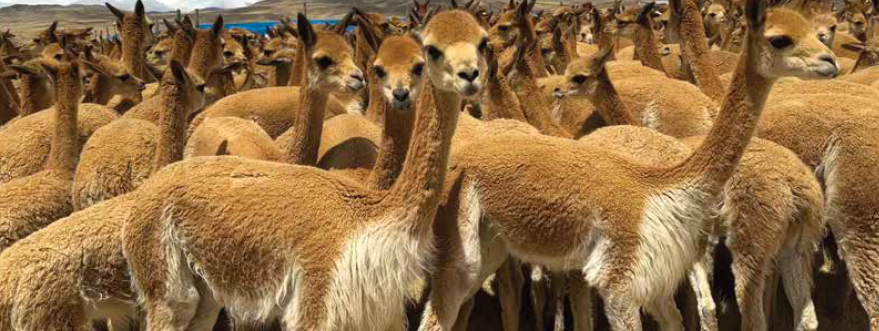
High in the Altiplano at 16,000ft where the air is very thin, we were so privileged to join with the local Quechua community at Picotani to share in their Chacu. The Chacu is the annual gathering together of the Vicuña for the shearing of their most highly prized and valuable fleece.
These people now manage the Vicuña and are responsible for their well being and their survival. In times past, the Vicuña were nearly rendered extinct as they were killed for their fleece. Now with careful management they are thriving. Together with these humble people who so openly welcomed us into their community and to participate in their ancient ceremonial rituals, we herded down the wild vicuña to the shearing area. We were in Peru with the Quechua Benefit 2024 Peru Tour and having read ‘Vicuña Survival of the Finest’ and followed the documentary ‘Salvation of the Vicuña’ by Mike Safley, to actually behold these magnificent creatures in such close proximity was deeply moving and an experience I for one, will never forget.
Vicuña too, have poo piles even though they are roaming free! They have natural family groups of about 5-7 animals with one macho guarding and herding their group. In late October these animals blend in perfectly with the landscape behind them and as we waited quietly at a rocky outcrop for the Quechua community to appear on the horizon with their bunting ropes outstretched, to herd down behind the Vicuna, we began to see the growing numbers of animals.
They came in their family groups, some quietly, some at pace, until the numbers amassed to some two thousand animals. The beauty of their eyes, their elegance and general calmness as the animals were herded down was truly something to behold. Following another ceremony where thanks were given for the successful Chacu and two Vicuña took part in a symbolic marriage, there was a period of dancing with our hosts. Quechua people know how to party, but at 16,000ft most of us were exhausted
within minutes of getting on our feet.
Shortly after, we were taken into the onsite shearing buildings and shown the process of Vicuña shearing. Prior to shearing, each animal is checked over and the length of their fleece measured. If the fleece is not long enough, they are released without shearing to wait for another year. Any health issues are treated as necessary and only fit Vicuña will be brought into the shearing area.
The animals were very carefully restrained as we watched the care and skill of the shearer, removing just the blanket from the animal. Each fleece was numbered and certificated, straight from the animal, before being rolled up and taken straight to the skirting table where they were picked over by two carefully trained women to remove any second cuts and/or stray long fibres (from the white areas on the Vicuña’s marking) that would otherwise contaminate the fleece. Each fleece would then progress to being washed and combed. It takes on average, 14 fleeces to make 1kg of Vicuña fibre which is one of the reasons why this fibre, together with its ultra fineness of between 11 to 14 micron is so prized and the most valuable, legally farmed fibre and why the feel of the fashion items produced from it, so exquisite.
Peru without doubt left an indelible mark upon us as we took in the breathtaking diverse landscape, the architecture and culture and rich diversity. Our small tour was accompanied throughout by two excellent Peruvian guides, in addition to Mike Safley, Amanda Vandenbosh and Dale Cantwell and the incredible wildlife photographer Robert Els, all of Quechua Benefit.
In two weeks, we packed in multiple destinations, architecture and ruins along with so many rich cultural visits. The Inca Trail and visit to Machu Pichu at the end of our tour was both an achievement and fabulous end to the most memorable and incredible experience. We had made new friends and strengthened existing friendships. If Peru is somewhere you are thinking about visiting, it comes highly recommended!
