

It is a soft April morning in West Sussex. The hedgerows are humming with bees, tulips stand to attention, and a blanket of dew still clings to the blades of grass. I’m standing in a large cottage garden surrounded by nodding daffodils, breathing in a curious scent—earthy, sweet, faintly hay-like. It’s not manure in the traditional, knock-you-sideways sense. It’s something gentler.
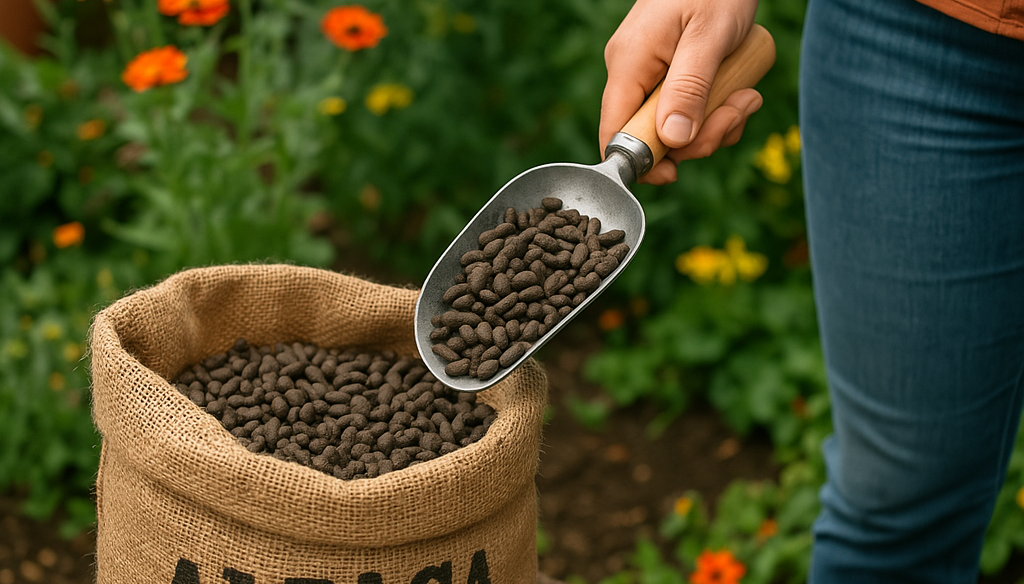
“It’s alpaca poo,” says gardener and alpaca owner Judy Fletcher, grinning. “We call it ‘beans’, because that’s exactly what it looks like.”
This is not just muck, it’s mulch magic. Welcome to the wonderfully weird and surprisingly refined world of gardening with alpaca dung.
Alpacas, unlike many of their barnyard cousins, have dainty digestive systems and usually a remarkably tidy attitude toward toileting. They use designated “latrine” spots in their paddocks, which makes collecting their waste a breeze, if not a joy, then certainly less of a chore than with other livestock.
“They’re such elegant animals, even their poo is polite,” Judy quips as she scoops a small pile into a wheelbarrow with practiced ease.
And unlike cow or horse manure, which must be composted thoroughly to avoid burning young roots, alpaca manure can be applied directly to plants without scorching them. It’s a ‘cold’ fertiliser, low in nitrogen but rich in potassium and phosphorus, making it ideal for flowering plants, fruiting shrubs, and veg beds alike.
“It’s gardener’s gold,” says Claire Brown of Weald View Alpacas in East Sussex. “It’s not a by-product, it’s a feature. More and more of us are realising that what comes out of an alpaca might be valuable, if only we could work out how to commercialise it”.
Judy’s garden is a living testament to the power of poo. In summer, her roses are voluptuous, her tomatoes tower like small trees, and even her reluctant asparagus patch has found a second wind. She brews a “tea” from the beans in old pillowcases, dunking the steeped liquid around plant bases like a gardener’s incantation.
“It doesn’t smell bad,” she insists, handing me a scoop to sniff. She’s right, it smells faintly sweet, like dried hay after rain. “I’ll bet it’s the only fertiliser in the world you can store in a hessian bag in your hallway.”
It’s even gentle enough to use on indoor plants. In a small conservatory just off her kitchen, Judy points out her lemon tree and potted geraniums, each of which receives an occasional handful of dried alpaca pellets.
“They love it,” she says. “It’s like vitamin pills for plants.”
Across the UK, smallholders and alpaca farmers are catching on. Bags of dried beans—often marketed as “Alpaca Gold” or “Paca Poo” now sell online, at country markets, and in specialist nurseries. Some are cleverly branded, some are bundled with seed packets or handwritten growing tips. The presentation varies, but the principle is the same: a natural, sustainable fertiliser, created by animals that tread lightly on the land.
“It’s part of the wider story of keeping alpacas,” Claire explains. “Yes, there’s the fleece, the trekking, the therapy, but the fertiliser is a brilliant little bonus. It makes alpacas feel more circular, more connected to the land they live on.”
And it’s no small thing: in peak grazing season, a single alpaca can produce around 300 grams of manure a day. Multiplied across a herd, and spread across a year, that’s enough to fertilise an entire market garden with room to spare.
In Whiltshire, I meet Tom Grayson, a retired teacher turned champion grower, who now uses alpaca dung almost exclusively on his vast allotment.
“At first, the committee laughed at me,” he says. “They called it boutique poo. But now they’re all asking me for a scoop.”
Tom doesn’t own alpacas himself, but he has a regular ‘supply agreement’ with a local herd. He cycles down once a week with a trailer in tow, collects several sacks, and returns to his patch where the beans are worked into compost bins, tea brews, and top dressings.
“I’ve never seen my courgettes so smug,” he adds.
The future of alpaca gardening may just be in its infancy. Some alpaca owners are experimenting with pelletising beans for easy scattering; others are exploring commercial compost blends. One Kent-based business has even partnered with a flower farm to create a bespoke potting mix containing alpaca fertiliser and dried lavender.
“It’s not for us, but I do think there’s a genuine eco-friendly market there,” says Claire. “It’s organic, low-odour, and completely sustainable. What’s not to love?”
As we walk through Judy’s garden once more, bees humming in the delphiniums and a robin bouncing across the lawn, I find myself looking differently at the neatly folded tarpaulin sacks lined up by the shed. Not as waste, but as treasure. A gift from the field, quietly offered. Nature’s own cycle of nourishment.
“It’s a small joy,” Judy says, pausing to sniff a peony. “But small joys add up, don’t they?”
She smiles, and behind her, one of her alpacas, Matilda looks on from the next-door field, entirely unaware of the horticultural wonders she helps to create.
If you’re just starting out, and thinking of getting alpacas? The British Alpaca Society offers free resources and a directory of accredited breeders. Also consider joining the South East Alpaca Group, a volunteer group affiliated with the BAS, who support alpaca and llama enthusiasts across the South East of England.