
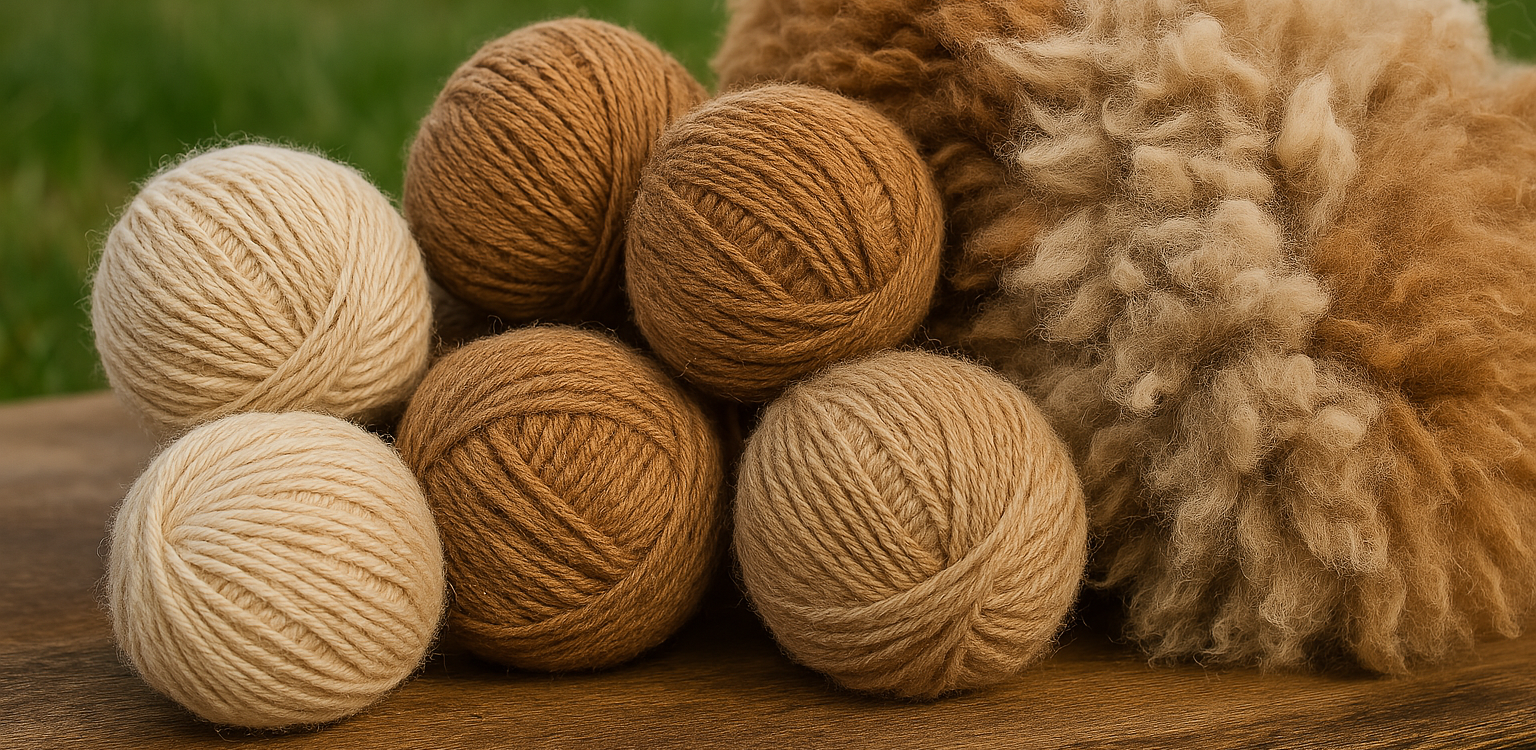
You’ve got alpacas. You’ve got fleece. You’ve maybe even got a few bin bags of it neatly labelled and stored in the garage, swearing that this will be the year you finally get it processed. But if you’re starting to take fleece seriously, perhaps even dreaming of your own yarn label or hoping to cover a few of your shearing bills with what you sell, then it’s time to talk about the other end of the pipeline.
Because if fleece is the product, your breeding choices are the business strategy.
Building a herd that reliably produces soft, spinnable, saleable fibre isn’t just for big commercial farms or championship show breeders. Anyone with a handful of alpacas can improve fleece quality over time, and even start producing yarn that earns its keep. Here’s how to get started, what traits to look for, and a few hard truths to keep you on track.
1) Know What You’re Aiming For
Before you can breed for better fibre, you need to define what “better” means for you. That sounds obvious, but fibre goals vary wildly depending on what you’re trying to make, sell, or improve.
Are you aiming to produce yarn for hand-knitters? Spinners? Commercial weavers? Felters? Are you dreaming of soft white DK yarn, or natural-coloured art batts for the local craft fair? Do you want to breed finer fleece, or just more of it? Uniformity? Staple length?
In general, for most small breeders hoping to create yarn for handcraft markets, the following traits are desirable:
- Low micron (ideally under 24µ for knitting yarn, under 20µ for next-to-skin luxury)
- Low standard deviation (SD) (which indicates consistency across the fleece)
- Good staple length (80–120mm is generally ideal for processing)
- Brightness and crimp (for visual appeal and yarn memory)
- Uniformity across the blanket (so the final yarn isn’t a bumpy surprise)
- Density (more fleece per animal, always a good thing)
Once you know your goals, you can start breeding with purpose.
2) Fibre First? Yes, But Don’t Forget the Alpaca
It’s tempting to focus purely on fleece stats when choosing animals for your fibre herd. And yes, fibre traits absolutely matter. But don’t fall into the trap of selecting only by micron count.
You still need animals with good conformation, solid health, and kind temperaments. After all, your high-end fleece-producing female won’t be worth much if she won’t stand still to be sheared or drops her cria in a ditch every year.
The good news? Many of the best fleece traits: density, uniformity, staple structure, go hand in hand with robust, well-bred alpacas. So you don’t need to choose one or the other. But be wary of chasing extreme fineness at the cost of everything else.
3) Fibre Testing: Stop Guessing, Start Measuring
This one is a game-changer. If you want to breed for better fibre, you have to get objective data. That means regular fibre testing, on every animal, every year.
Labs like AAFT and Art of Fibre can analyse your fleece and give you detailed reports on:
- Mean fibre diameter (micron)
- Standard deviation
- Coefficient of variation (CV%)
- Comfort factor
- Fibre curvature
- Staple length
These numbers help you make smart breeding decisions, track progress year-on-year, and, crucially, avoid accidentally breeding animals whose fibre looks nice but hides a coarse or variable profile.
Yes, it costs money. But it’s a fraction of what you’d spend on an ill-informed mating. Think of it as a tiny investment with massive long-term return.
4) Choose Males Like You’re Hiring for a Very Specific Job
The single most powerful tool in your fibre improvement toolbox is your choice of stud. And yet, far too many breeders choose studs based on convenience, colour, or vague pedigree prestige.
If you want your herd to improve, you need to match your female’s weaknesses to a male’s strengths, with data. For example:
If your female has lovely fine fleece but low density, choose a male known for density.
If she has good fibre stats but poor uniformity across her body, find a male with a tight SD and proven consistency.
If she’s fine but the fibre lacks structure or brightness, look for a male whose fleece is springy, crimped, and shiny.
Ask for fibre stats, not just current ones, but also their offspring’s. A male with great fleece himself isn’t necessarily passing it on. You want a proven producer of elite fibre traits, not just a pretty face.
And don’t be afraid to go outside your own herd or area. Transporting a female for a good stud service is often cheaper than raising a cria that won’t improve your line.
5) Breed for Progress, Not Perfection
You won’t create a fleece superstar in one generation, and you don’t need to.
Fibre breeding is about consistent, steady gains. If your female produces a cria with a 1–2 micron improvement, better SD, and improved brightness or structure, that’s a win. Build on that next year. Think of each generation like a rung on the ladder.
Also, remember that alpacas keep producing fibre their whole lives. Don’t give up on an animal just because her stats aren’t perfect, her offspring might surprise you, especially with the right male.
And if you’ve bred something truly spectacular? Celebrate it, but keep striving. There’s always another fleece to improve.
6) Start Paying Attention to Uniformity
If there’s one trait that often gets overlooked in favour of micron count, it’s uniformity, and that’s a big mistake.
A fleece that is uniformly 24 microns is far nicer to process than one that’s a mix of 20s and 30s. Spinners and mills alike hate variability. It makes yarn bumpy, difficult to blend, and uncomfortable to wear. A tight SD (standard deviation) and CV% are signs of a fleece that will process well and feel good in the finished product.
Look for:
- Uniformity across the blanket
- Uniformity within each staple
- Consistency over time (not just first fleece)
Breeding for uniformity takes time and careful selection, but it pays off in beautiful, usable fibre.
7) Colour is a Fibre Trait Too… Sort Of
Colour doesn’t directly affect fleece quality, but it does matter if you’re producing yarn or selling fleece to handcrafters.
White is the most versatile, it can be dyed any colour, so mills and crafters often prefer it. But natural colours (especially fawns, browns, and greys) are increasingly popular with eco-conscious customers and felters.
If you’re breeding for coloured fibre, aim for clarity and evenness. Patchy colour or heavy banding can be lovely on the animal, but a nightmare for yarn production.
And just like with other traits, if colour is part of your fibre plan, select for it deliberately. Don’t just let nature surprise you.
8) Don’t Forget Density and Yield
Softness is lovely. But if you want to produce fibre that pays its way, you need volume. A beautiful fleece that weighs 800g skirted isn’t going to bring in much yarn. A lovely fleece that weighs 2.4kg? Now we’re talking.
Dense fleeces give you more bang for your shearing buck. They also tend to grow back more consistently and give you more choices when sending to the mill.
You can estimate fleece yield at shearing time, but the best breeders track fleece weights year on year, right alongside the fibre stats. Over time, aim to breed animals that are both soft and productive. That’s where profitability lies.
9) Use Your Fleece Results to Guide Herd Decisions
Once you’ve got a few years of fleece data under your belt, you can start making smart, informed decisions about your herd:
- Who to keep breeding (the producers of your best fleece? Breed them again!)
- Who to retire (if an older female’s cria keep going backwards in fibre quality)
- Who to sell (even lovely animals can be moved on if they don’t fit your goals)
- Which males are delivering (or not)
Tracking fleece quality helps you shift from reactive to proactive breeding. You stop guessing, and start improving.
10) Share What You’re Doing (It Helps Everyone)
Breeding for fibre used to be seen as secondary to the show ring or the pet market. But that’s changing, fast. More and more UK breeders are focusing on fleece quality, processing their fibre, and building small-scale yarn brands.
If you’re working to improve your herd’s fleece and create saleable fibre, talk about it. Share photos. Post your yarn. Tell your local spinners and felters. Mention fibre stats when you sell stock. Submit fleeces to competitions. Swap tips with fellow breeders.
The more we normalise fibre-focused breeding in the alpaca world, the more value we’ll all get from these incredible animals—and their incredible fleece.
Final Thoughts: You Don’t Need 100 Alpacas to Breed for Better Fibre
This isn’t just for big breeders with barns full of ribbon-winning stock. If you’ve got three alpacas and a dream of producing yarn, you can start now. Learn what makes a good fleece. Get some fibre testing done. Choose your stud services with purpose. Keep the good ones. Improve the rest. And don’t be afraid to ask for help or advice, there’s a whole community of fibre-loving alpaca folk out there.
Your herd doesn’t have to be perfect, but if your fleeces get better every year, you’re on the right path.
And before long, that yarn might just pay for the shearer, the hay bill, or even the next stud fee. All from some soft, shiny, home-grown fibre, and a bit of smart breeding.
Message from the South East Alpaca Group committee. We know that no two herds, or herd owners, are the same. We hope you found this article useful and if you’ve got ideas, suggestions, corrections, or just a different way of doing things, we’d love to hear from you. Our goal is to offer the most accurate, practical, and useful advice possible, and that works best when we all pitch in. Drop us a line at committee@southeastalpacagroup.org.uk and help us make our articles better.