
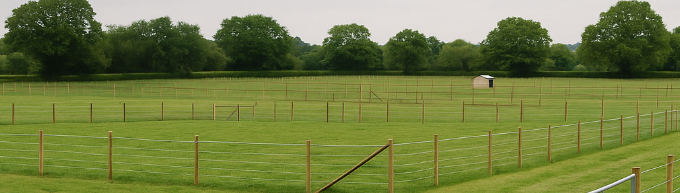
Owning alpacas often means working with modest acreage, especially as land prices continue to rise and smallholdings become the norm rather than the exception. Whether you’re working with three acres or ten, the challenge is the same: how to balance good pasture management, animal welfare, and long-term sustainability on limited land.
Grazing strategy is one of the most important, and often overlooked, aspects of alpaca ownership. New owners sometimes assume alpacas are “low impact” grazers and simply leave them to roam, but this can quickly lead to overgrazing, poor soil, and unhappy animals. The truth is, small herds need more careful planning, not less.
Good grazing management isn’t about having lots of land. It’s about using the land you do have intelligently. This means thinking ahead, watching your pastures closely, and creating a rotation system that gives the grass time to rest and recover. With the right infrastructure and approach, even five or six acres can support a healthy, thriving herd.
Understanding Alpaca Grazing Habits
Alpacas graze differently from sheep or cattle. They are spot grazers, preferring specific patches and returning to the same areas again and again. They also avoid soiled ground, which is great for parasite control but can lead to uneven grazing patterns. Some parts of the field are chewed down to a lawn, others grow tall and coarse.
Alpacas also don’t graze close to the root like sheep. This makes them gentler on the pasture in one sense, but if they’re left too long in the same area, the constant trampling and dunging can compact the soil and damage the sward. On the heavy clay soils common in the South East, this becomes even more of a problem.
Overgrazing isn’t just about eating the grass too short. It’s about not giving the pasture enough time to recover. A rotation system, even a simple one, helps break up parasite cycles, improves pasture diversity, and keeps your herd moving and active.
The rule of thumb is simple: You’re not feeding the alpacas. You’re feeding the grass, which feeds the alpacas.
Designing Your Fields for Function
You don’t need fancy equipment or perfectly squared fields, but a bit of design goes a long way. The ideal layout for rotation includes several paddocks that can be accessed easily from a central point, usually your barn or shelter area. This could look like a wagon-wheel pattern with gates radiating out from a hub, or simply a series of parallel paddocks linked with gates.
The key considerations are:
- Shelter in each paddock, whether permanent or mobile.
- Water access that doesn’t require trailing hoses across three fields.
- Tramways that allow for movement of animals.
- Gate placement that avoids creating a mud pit in winter.
- Machinery access for topping, rolling, or moving hay.
Fencing doesn’t need to be elaborate. Most alpacas respect boundaries, but fences need to be at least 4 foot (120cms) without any barbed wire, and make sure your gates are wide enough for a tractor, at least 10 feet.
If you’re retrofitting a field that wasn’t designed for rotation, temporary fencing can be a cost-effective way to split a large field into paddocks.
Smart Rotation for Small Herds
How many paddocks do you really need? More than two. Ideally, at least four separate grazing areas allows for proper rotation. With three, you can begin to build a cycle. With four or more, you can truly rest each paddock between uses.
A good starting point for small herds:
- 3–4 alpacas on 3 acres: Divide into four paddocks of roughly three-quarters of an acre each.
- 8–10 alpacas on 6 acres: Divide into five or six paddocks of 1 to 1.25 acres.
In the growing season (spring and early summer), each paddock may only need a two-week grazing period, followed by six to eight weeks of rest. In late summer or during drought conditions, rest periods may need to stretch longer. Winter may require a “sacrifice paddock”, a designated area where damage is accepted so the others can recover.
Watch your grass. When it reaches boot-top height (around 4–5 inches), it’s generally ready to graze again. After you move the alpacas out, leave the field until it rebounds. Spot topping with a mower or brush cutter can help encourage fresh growth.
You don’t need to rotate every group the same way. Pregnant females may benefit from longer periods in one paddock for stability. Groups with cria may need shelter and clean, soft ground. Flexibility is the key.
Supporting Pasture Recovery
Once you start rotating, your attention turns to pasture health. South East soils are varied, but many are on the heavier side, chalky clay or loam with poor drainage. Compaction is common, and neglected paddocks quickly develop mossy patches, weeds, and coarse grasses.
Recovery isn’t passive. It takes attention:
Overseed patchy areas in early autumn or spring with hardy mixes: low-sugar ryegrass, meadow fescue, and forage herbs like chicory or plantain.
Soil test every few years to check pH and nutrient levels. Many pastures in the South East are too acidic or low in phosphorus.
Top fields after grazing to even the height and knock back weeds.
Harrow in spring to break up dung piles and encourage tillering.
Avoid broad-spectrum herbicides unless absolutely necessary. Docks, nettles, and ragwort can be managed with good topping and rotation. If you need to treat a field, remove alpacas and allow time for regrowth before returning them.
Some fields benefit from rolling, especially after a wet winter. This helps level poached areas and improves seed contact for overseeding. But don’t overdo it, rolling can worsen compaction if your soil is already heavy.
Managing Mud and Wear Zones
Mud is a fact of life. Between autumn and spring, it feels like it never stops raining. Gateways, water troughs, and shelter entrances take a beating.
Plan for this.
- Use hardcore, hoggin, or road planings around gates.
- Rubber matting can be laid at shelter entrances or in high-wear areas.
- Raise water troughs slightly and site them on hard ground.
Designate a sacrifice paddock in winter to take the brunt of the damage.
This paddock should be close to shelter and easy to clean. It won’t look pretty, but it saves the rest of your land. You can overseed and rest it in spring.
A few planks or slabs placed where the alpacas walk most often can save hours of mucking out later. The goal isn’t to eliminate mud, it’s to manage it.
Field Infrastructure That Works for You
Good infrastructure makes grazing easier to manage and more enjoyable. You don’t need to spend thousands, but strategic investment saves time.
Install gates you can operate with one hand (or from horseback height if you’re feeding from a quad).
- Use metal field shelters on skids so you can move them each season.
- Consider a mobile hay station on wheels.
- Put in buried water lines with taps in each paddock, it’s easier than moving troughs every month.
- Keep a muck barrow and fork in each field corner to stay on top of dung removal.
Optional extras like pasture cameras or wildlife cams can help you spot foxes, badgers, or unexpected visitors, and give you insights into how the herd uses different areas.
Seasonal Shifts and Contingency Plans
UK weather patterns bring hot, dry summers and long, wet winters. Rotation plans need to adapt.
In drought, grass growth slows and rotation stretches. Supplement with hay before fields are exhausted.
In winter, rotate only if ground allows. If not, stick to the sacrifice paddock and protect the rest.
Never let fields become too short, below 2 inches, grass struggles to recover, and weed invasion begins.
Plan for one paddock to be taken out of rotation each year for reseeding or resting.
If you plan to cut hay from your own land, factor that field out of grazing for the early part of the year. It’s best if it’s not your best winter paddock.
Conclusion
Alpacas don’t need vast acreage, but they do need careful management. With a good layout, thoughtful rotation, and a plan for the seasons, even a small plot can be productive, low-stress, and resilient.
Think of pasture like a battery. Each time you graze, you draw power. Each period of rest is a recharge. If you take out more than you put in, the battery dies. But with the right system, your pasture can power your herd for years to come.
Good grazing is more than just moving animals. It’s the foundation of a healthy, happy alpaca enterprise, especially here in the UK, where every square metre counts.