
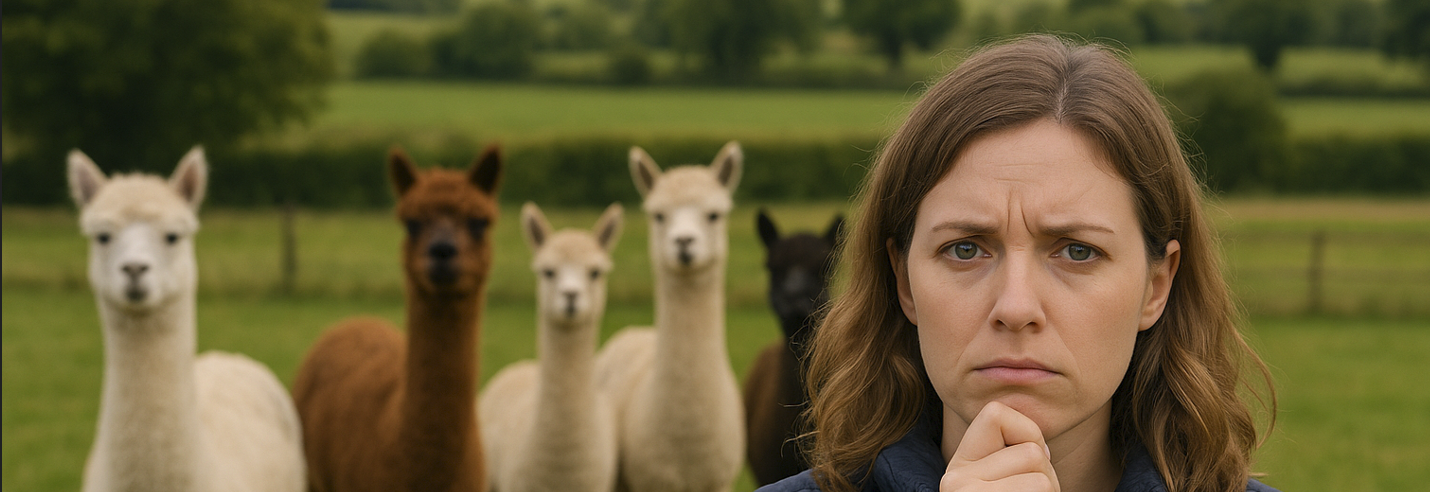
There’s a special kind of optimism that fuels the first-time alpaca owner. It’s the same twinkle-eyed confidence you see in someone who’s bought a DIY hot tub kit or thinks they can “quickly” tile a bathroom floor. Alpacas are fluffy, soulful, mysterious creatures, and when you’re starting out, everything feels like magic. Until it doesn’t.
So, to save your future self a few grey hairs (and your alpacas a few disgruntled hums), here are the 10 most common, and entirely fixable, mistakes that most new alpaca owners usually make.
Mistake 1) Thinking Alpacas Are Like Sheep, Just Taller and More Instagrammable
Oh no, no, no. Sheep and alpacas are as alike as chalk and a smug, fleece-covered cheese. Alpacas don’t herd in the same way, they don’t graze the same, and they do not appreciate being chased around a field. New owners often assume alpacas will behave like familiar livestock, and are then completely flummoxed when the alpacas hop a fence, hum in distress, or line up to collectively ignore a bucket of feed.
Fix it: Learn their language. Alpacas are visual communicators, they respond to calm, quiet movement, and they’ll test your patience before they trust your presence. Earn it.
Mistake 2) Underestimating Their Ability to Escape
If you’ve built your fencing based on what would contain a goat, a sheep, or a moderately clever dog, I regret to inform you it’s probably not enough. Alpacas don’t chew through fences, they float over, under, or through them. Especially if they’re young, frisky, or determined to explore yours or a neighbour’s garden.
Fix it: Fencing should be at least 4.5–5 feet high, well-tensioned, with no gaps alpacas can sneak under. And please, please test the gates. There’s always one alpaca who knows how to unlatch the field gate. Make sure your fencing doesn’t include barbed wire.
Mistake 3) Feeding Them Like Horses (or Rabbits… or Your Cousin’s Llama)
I’ve seen it all, pellets meant for goats, bags of “multispecies” treats, and someone earnestly offering a banana. Alpacas have highly specific dietary needs, and too much rich feed can cause obesity, dental issues, or dangerous mineral imbalances.
Fix it: Stick to high-quality hay, grazing, and alpaca-specific feed. Balance the minerals. Keep a close eye on your youngsters, your elderly, and anyone whose condition seems to be dipping. And no, they don’t need treats. (Even if they do look like they’d love a digestive biscuit.)
Mistake 4) Assuming They’ll Be Friendly Just Because You’re Nice
Alpacas don’t automatically warm to you because you’re gentle and softly spoken. They are prey animals, hard-wired for suspicion. You might’ve dreamt of cuddles and soulful eye contact—what you get is often side-eye and a calculated 3-metre buffer zone.
Fix it: Relationship-building with alpacas takes time. Daily, calm interaction, especially at feeding times, is your best tool. Let them approach you, never force contact, and don’t take the spitting personally. It’s not you (probably). It’s the pecking order.
Mistake 5) Thinking You’ll Figure It Out as You Go
This one is a big one. Too many first-time owners go in without training, mentoring, or even a basic care book. You wouldn’t buy a vintage tractor without knowing how to service the brakes, so why take on a 70kg woolly enigma with zero prep?
Fix it: Go on an alpaca husbandry course. Read every reputable alpaca care book you can find. Make friends with your local alpaca vet (hello). And maybe, just maybe, visit a few other owners and watch. The best education is standing in a muddy field, learning what a ‘normal’ poo pile looks like, or offer to help during shearing.
Mistake 6) Ignoring Body Condition Because They Look So Fluffy
You can’t see weight loss under fleece, and by the time it’s visible, it’s usually too late. Singleton crias, elderly animals, or ones lower in the hierarchy can quietly waste away while looking deceptively round.
Fix it: Learn how to body score an alpaca with your hands along the spine and ribs. Do it weekly. Record it. Keep an eye on those who seem to hang back at feeding time. Being the fluffiest doesn’t mean being the healthiest.
Mistake 7) Treating All Alpacas the Same
Every alpaca is an individual. Some are bossy. Some are anxious. Some are prone to dental issues or skin problems. And each one needs different handling, feed amounts, and veterinary oversight.
Fix it: Track your animals like a schoolteacher with a report card. Keep notes on weight, behaviour, worming dates, and anything odd. Learn their personalities and adapt your care to suit. Cookie-cutter care leads to avoidable problems.
Mistake 8) Neglecting poo (ideally it’s in a heap) until It’s a Problem
Ah, the glamorous life of an alpaca owner. One minute you’re admiring a cria’s first steps, the next you’re knee-deep in a poo that’s become a fly breeding ground.
Fix it: Have a waste management plan from day one. Regular paddock poo-picking is a must, ideally daily. Compost what you can. Rotate fields. A clean paddock isn’t just nicer, it reduces parasite loads and supports good health.
Mistake 9) Waiting Too Long to Call the Vet
Alpacas are the stoics of the livestock world. They mask illness, often until things are critical. New owners can miss early signs, like subtle weight loss, a quieter demeanour, or a reluctance to move, until it’s too late.
Fix it: If something seems off, don’t wait. Call your camelid-savvy vet. (Not every vet is comfortable with alpacas, check that yours is.) It’s always better to get a “false alarm” diagnosis than to treat a late-stage crisis.
Mistake 10) Forgetting They’re a Long-Term Commitment
Alpacas live 15–20 years. That’s longer than some marriages and certainly longer than most garden landscaping plans. And they need care every day, yes, even on holidays, during school runs, or when it’s raining sideways.
Fix it: Make a long-term plan. Who’s your backup if you’re away? Can your infrastructure cope with elderly animals? Are you prepared to make end-of-life decisions with kindness and compassion when the time comes? Don’t go into alpaca ownership lightly, it’s not a fling. It’s a fleece-covered marriage.
In Conclusion
Alpacas are addictive. Once they’re in your life, they tend to stay there, alongside a selection of wellies, vet bills, and tales of bizarre field-based antics. But while the learning curve is steep, it doesn’t have to be painful. With the right prep, mindset, and support, you can avoid the most common pitfalls and build a healthy, happy herd.
And if you do make one of these mistakes? Welcome to the club. We’ve all done it, some of us more than once. What matters is learning, adjusting, and remembering that your alpacas are watching you. Judging you, maybe. But also hoping you’ll get it right… eventually.
Thinking of getting alpacas? The British Alpaca Society offers free resources and a directory of accredited breeders. Also consider joining the South East Alpaca Group, a volunteer group affiliated with the BAS, who support alpaca and llama enthusiasts across the South East of England.
Message from the South East Alpaca Group committee. We know that no two herds, or herd owners, are the same. We hope you found this article useful and if you’ve got ideas, suggestions, corrections, or just a different way of doing things, we’d love to hear from you. Our goal is to offer the most accurate, practical, and useful advice possible, and that works best when we all pitch in. Drop us a line at committee@southeastalpacagroup.org.uk and help us make our articles better.